by Stephen Lendman
Even the powerful are worried with the IMF on February 7 saying advanced economies are in "depression (and) the worst cannot be ruled out." Forecasting a 2010 recovery is "very uncertain" at this time as further financial turmoil may disrupt it regardless of policies adopted, and trouble is outpacing resources to alleviate it.
On March 10, its Managing Director Dominique Strauss-Kahn forecast "below zero" 2009 global growth - what he termed "the worst performance in most of our lifetimes."
In a March 8, report, the World Bank expressed similar gloom saying:
-- "developing countries face a financing shortfall of $270 - 700 billion this year, as private sector creditors shun emerging markets, and only one quarter of the most vulnerable countries have the resources to prevent a rise in poverty;"
-- international financial institutions alone can't cover the (public, private and trade deficit) shortfalls for these 129 countries, so other help is needed - a "global solution" to prevent an economic catastrophe;
-- the global economy "is likely to shrink this year for the first time since World War Two, with growth at least 5 percentage points below potential;"
-- by mid-2009, global industrial production may be 15% lower than 2008 levels, a shocking differential reminiscent of the 1930s;
-- 2009 "world trade is on track to record its largest decline in 80 years, with the sharpest losses in East Asia;"
-- "the financial crisis will have long-term implications for developing countries" (and developed ones as well); they face higher borrowing costs, lower capital flows, weaker investment, and slower future growth at a very grim time globally.
At the same time, the Asian Development Bank (ADB) reported 2008 shrinkage of over $50 trillion in investor wealth, a shocking decline reflecting financial asset losses in stocks, bonds, currencies, real estate, and various other investments as well as a "surprising run" to the dollar in search of a safe-haven.
ADB said world's financial markets experienced "the most violent shock" since the Great Depression and global economies have rapidly deteriorated. Bank president Haruhiko Kuroda stated: "I'm afraid things may get worse before they get any better," maybe much worse. Yet his solution (like the IMF's and World Bank) is worse than the problem by proposing more debt on top of today's burden. He wants a 200% ADB capitalization increase, similar to though not as extreme as Fed policy, so instead of reducing Asian debt, he wants to increase it, make heavily-indebted nations more indebted, and let taxes, borrowing, and fewer social services bear the burden of a growing calamity the way America is doing it.
The solution to over-indebtedness, of course, is get free of it, but that doesn't work well for bankers, and in the end they generally get what they want, so the rest of us lose out and today's crisis will continue to worsen.
Warren Buffett to the Rescue - Again
It's so bad that Wall Street rolled out Warren Buffett for the second time to do what he rarely does - last October in a New York Times op-ed to calm investors and affirm his faith in "the long-term prosperity of the nation's many sound companies."
On CNBC March 9, he wasn't as sanguine saying the economy has "fallen off a cliff. (It's) in a shambles. Not only has (it) slowed down, people have changed their behavior like nothing I have ever seen (and government policy or at least its message has been) muddled." Then commenting on the importance of personal housing wealth and how much of it's been lost, he went the old adage one better about "the emperor ha(ving) no clothes."
"On top of that," he said, "the emperor doesn't have any underwear either." As a result, "We are in a very, very vicious negative feedback cycle" because people are scared to death and with good reason.
But Buffett didn't do a lengthy Q & A to scare people. He was there as a pitchman, a hawker like in a carnival, and his product is his own company, Berkshire-Hathaway, and America. When asked "Will everything be all right," he responded:
"Everything will be all right. We do have the greatest economic machine that man has ever created....(It's because) we ha(ve) a system that work(s). (It's gotten us through) six panics in the 19th century (and) in the 20th century we had the Great Depression and World Wars, all kinds of things. But we have a system, largely free market, rule of law, equality of opportunity (unleashing) human potential (so) your grandchildren will live better than your kids."
"The machine works (and buying) equities (is) the way to (profit from it). If (you) buy the right businesses, (you'll) do very well....American business will be worth more over time....Stocks will be worth more over time. I guarantee you that the Dow will be a lot higher."
Last October in his New York Times op-ed, Buffett said he's "buying American stocks." On March 9, he repeated the message even though the economy "is a shambles." Serious enough to need "the Oracle of Omaha" to save it, or at least try by making a public spectacle of himself on TV, and it wasn't the first time although others were more focused on his business or general view of things.
This time, stressing America's long-term strength, he ignored its fundamental weaknesses and systemic failure at the root of today's problems:
-- a system so unstable, crisis-prone, exploitive, unfair, self-destructive, and corrupted it can't endure;
-- Keynes warning about the consequences of "enterprise becom(ing) the bubble on a whirlpool of speculation;"
-- the inevitable decay that Marx and others predicted;
-- the untenability of great wealth disparities with few having too much and many too little - something untenable in the long run;
-- Lincoln's June 16, 1858 message to the Illinois Republican State Convention - that "A house divided against itself cannot stand;" slavery was the issue then; today it's inequality, human need, and growing poverty under a fundamentally unworkable system favoring wealth over public welfare.
Something else bothered Buffett as well - that Berkshire Hathaway (B-H) stock lost half its value, and the company had its worst ever year in 2008 since Buffett took it over in 1965 when it was a family-run textile maker. He's also not immune to credit default swap (CDS) problems, having increased his position to $14 billion as of year end 2008, and last year took hundreds of millions in write-offs as a result.
Further, some question B-H's health going forward given the current environment, insurance being his main business, and the worrisome CDS spreads on his debt. According to Merrill Lynch's Michaels Hartnett and Penn, they trade at wider spreads than those for Vietnam. They point out that GE is no better off as their swaps are wider than Russia's at a time its economy is reeling like many others.
Through March 11, B-H and GE were two of the six remaining companies rated AAA by S & P, according to CreditGuru.com. The others are ExxonMobil, Toyota, J & J, and ADP. In the late 1970s, 58 companies had the rating. That was then. This is now as two more of the mighty have fallen.
On March 12, the Wall Street Journal online reported that "General Electric Co. and its finance arm (GE Capital) have lost their coveted AAA long-term credit rating from Standard & Poors Ratings Service" when the agency cut it to AA+ in a move many analysts think was long overdue but not enough given the company's troubled state.
On the same day, Bloomberg reported that Fitch Ratings "cited concern about (B-H's) potential for losses on (its) equity and derivatives holdings" in cutting it to AA+ and its senior unsecured debt to AA." Bloomberg added: "Some investors (believe) the derivatives may saddle (B-H) with billions of (future) losses."
Economists and Financial Writers on The Global Research News Hour
Notable ones like F. William Engdahl, Michael Hudson, Ellen Brown, Jack Rasmus, Richard Wolff, John Bellamy Foster, and John Williams continue explaining the nature and consequences of the global economic crisis, and how it affects ordinary people. For example, Rasmus and Williams believe that the economy lost from 800,000 - 1,000,000 jobs for the past four months (not the Labor Department's lower figures) on top of all those lost earlier, and no end to the carnage is in sight.
According to the Economic Policy Institute (EPI), over 23 million Americans were either out of work or underemployed in February, and the numbers are growing. In addition, 60.3% of the population has some form of employment, down from 63.4% in December 2006. EPI reported that BLS figures show job openings fell 7.2% in January to three million, down 32% from year end 2007. Currently there are over four unemployed workers for every job, and seekers "are seeing their chances of finding (employment) grow ever dimmer."
Reports are that jobs are being lost at the rate of one every five seconds, and according to Manpower International's US employer survey, hiring plans are the lowest since the company began polling in 1982. A slim 1% of firms expect to hire in Q 2, down from 10% in Q 1 and off 15% from Q 2, 2008. A company official said: "That's about as bad as it gets with our survey," but it looks like worse is still ahead.
Consider the latest initial jobless claim filings for the week ending March 6 - a record 654,000 following the previous week's upwardly revised 645,000. People getting benefits for more than a week increased by 193,000 to 5.3 million, another record high, and it's the sixth time in the past seven weeks that new records have been set. The proportion of the work force getting unemployment benefits is the highest since June 1983 when the economy began emerging from a deep recession. One year ago, only 2.8 million got benefits. Today the numbers are skyrocketing with no end of it in sight. It shows in the monthly payroll data.
In his latest ShadowStats report, Williams said February's payroll loss was 899,999 and unemployment reached 19.1%, when discouraged and involuntary part-time workers are included. He compared it to Great Depression 25% levels but noted then they may have been higher because measures included only non-farm workers at a time agriculture was over one-fourth of the economy and farm labor much greater in numbers than today. According to the US Department of Agriculture, it's now less than 2% of all workers so its impact on employment is marginal.
Challenger, Gray & Christmas (CG&C) tracks monthly announced job cuts, now making grim reading. On February 4, it reported:
"Company layoff announcements were unusually heavy in January, indicating that the shock to the labor force is increasing in intensity and pointing to severely depressed readings in Friday's employment report." CG&C cited 241,749 compared to 166,348 in December, or the highest figure since the end of the last recession. By comparison, January layoffs a year ago were only 74,986. Of great concern is how much higher numbers will go and for how many more months.
CG&C's February total slipped to 186,350, but it cautioned to "distinguish between layoffs scheduled for the short-term or the long-term, or whether job cuts are handled through attrition or actual layoffs." Most important is the trend, not monthly blips up or down that obscure it, and the latest home foreclosure data aren't reassuring.
On March 11, Dow Jones Newswires reported that completed US foreclosures soared 67% in February over January, putting them at their highest since the start of the crisis, according to Foreclosures.com.
Most worrisome is that they came in spite of Fannie, Freddie, and several major banks putting a temporary halt to the process, yet it persists at severely high levels. In addition, pre-foreclosure filings (an indicator of future foreclosures) jumped 27% to 207,703, topping December's highest ever number by 9%. Three of the hardest-hit states continued impacted with California soaring 67% from January, Florida 42%, and Arizona more than doubling. The data suggest more of the same ahead with perhaps millions more homeowners facing loss of their most valued asset and little in the way of government help to prevent it.
Citigroup on the Ropes, or Are They?
Believe the former despite its CEO saying that January and February were profitable. Take it with a grain of salt given its $37 trillion derivatives portfolio, much of it toxic, and its stock price at a buck - until The New York Times published a "leaked" confidential memo from Vikram Pandit to employees saying the company was on track for its best quarter since late 2007 when the market started to implode.
Left out was how numbers are calculated - based on operating, not reported earnings, excluding lots of write-offs but mostly ones left undeclared hoping investors won't notice and think the bank healthy again. On March 10, the market responded positively with Citi and other financials doing best, but for how long. Nothing changed in a very weak economy, and Citi is among the sickest banks in it, insolvent and on the edge of bankruptcy or being nationalized.
The McKinsey & Company consulting firm may agree in its recent bank profitability forecast. It states "2009 will be unprofitable (and) net investment income "drops dramatically in 2009 as deposit spreads compress (reflecting consumer and commercial), then (begin to recover) going forward. Yet by 2013, McKinsey sees revenues at $142 - 153 billion compared to $156 billion in 2008 with profits beginning to pick up after up after $53 billion in 2009 operating losses. For 2008, McKinsey said banks posted a $1 billion profit, excluding all taken and untaken write-offs. It affirms a very sick industry with no prospect of profits if they're included.
Institutional Risk Analytics co-founder and managing director Chris Whalen agrees in his March 13 analysis titled: "Stress Test Zombies - Not Too Big to Fail? Tough Tootsies Little Banks!" He refers to Bernanke and Geithner "cowardly feed(ing) the zombies." It's "not sustainable financially" nor workable politically and must eventually be changed. At some point, "the Obama administration may need to choose between our (banks and) foreign creditors and American voters."
"The Bernanke/Geithner approach to not dealing with the financial crisis amounts to a hideous public subsidy, a transfer of wealth from American taxpayers to the institutional investors who hold the bonds and derivative obligations tied to the zombie banks, AIG and the GSEs." All these companies will need continued cash subsidies in the trillions of dollars to keep them out of bankruptcy.
Yet imagine, Bernanke and Geithner are proceeding on their own. "No legislation has been passed and no meaningful debate has occurred. The biggest danger facing the markets is that Ben and Tim still do not seem to have a clue what to do about the big banks -- other than to write more checks against the public trust. The conflict over this decision to pass the cost to the taxpayer, between the Fed, Treasury and the Congress, on the one hand, and the Wall Street dealer banks is staggering, yet nothing is said in the Big Media."
The fact is that "bailing out toxic waste sites....could cost trillions of dollars....The only issue is whether we recognize it directly, via a public resolution, or hide (it) via public subsidies and future inflation."
The right strategy is to break up or close down zombie banks, keep taxpayers out of it, and let bond and equity holders absorb the cost of "marking (their) assets to market" and ending the charade that they're profitable or heading toward it.
On March 10, the Wall Street Journal's front page reported that repeated Citi bailouts haven't helped so "US officials are examining what fresh steps they might need to take to stabilize the bank if its problems mount, according to people familiar with the matter....(called) 'contingency planning.' " Weekend discussions were held with Citi officials downplaying their seriousness. But given the bank's condition, profitability claims (the next day) are deceptive, so how long can the charade continue.
Further, on March 12 according to Bloomberg.com, there's more. "Four Citigroup Inc. executives who bought the bank's stock last week have already generated a $2.2 million paper profit, regulatory filings show." Insiders included:
-- director Roberto Hernandez bought six million shares on March 2 at an average $1.25 price; after briefly dipping below $1, it closed on March 5 at $1.52 for a paper profit of $1.7 million;
-- Latin America CEO Manuel Medina-Mora bought 1.5 million shares on March 3 at an average $1.24; and
-- other buyers included vice-chairman Lewis Kaden buying 100,000 shares and controller and chief accounting officer John Gerspach 65,000 shares - in each case ahead of Pandit's profitability claim and the day earlier Wall Street Journal front page story saying Citi is in trouble.
Another key point is that the US Securities Exchange Act of 1934 "prohibit(s) the making of false or misleading statements to a public company's auditors." It's also "a crime to knowingly and willfully make a false or fraudulent statement in any matter within the jurisdiction of the executive, legislative, or judicial branch of the US government" (18 U.S.C. 1001, January 2007). Further, it's unlawful to mislead investors or violate any provision of the 1934 act. True or false, Pandit's memo was internal and only covered a two-month period, not the full Q 1 filing for after March 31, so likely no violation occurred.
That aside, there's the issue of stock manipulation and insider trading with the above-cited evidence casting suspicion. It's illegal for anyone to buy or sell securities based on non-public information, and those doing it face prosecution if caught. A high-profile case was against former Qwest CEO Joseph Nacchio - indicted in December 2005 on 42 insider trading counts involving $100 million worth of his company's stock, then convicted on 19 counts in April 2007. He was sentenced to six years in prison and ordered to forfeit $52 million in fraudulently earned profits plus a $19 million fine, $1 million for each count.
The Wages of Reckless Spending
They're painful, costly and, according to Michel Chossudovsky, heading the country for "fiscal collapse" in an analysis that's stunning but unsurprising. A "Second New Deal?" Quite the contrary to:
-- continue the most massive wealth transfer in history;
-- achieve it by looting the Treasury;
-- build a crushing debt burden;
-- undertake "the most drastic curtailment in public spending in American history;"
-- govern under a war budget directing most revenues for defense, militarism, and foreign wars; trillions for "the Wall Street bank bailout;" and servicing the enormous public debt - in 2008 an astonishing $451 billion;
-- provide no fiscal stimulus for the economy; in fact, do the opposite by requiring no mandate that banks lend; instead, let them speculate and use hundreds of billions to buy real assets (the "real economy") on the cheap after their stock prices have been manipulated to crash;
-- impoverish tens of millions of Americans through reduced social services when they're losing jobs, homes, savings, pensions and futures; and at the same time
-- privatize America to pay for reckless spending - everything: "public services," infrastructure, highways, national parks, various other state assets, the entire State sold on the cheap to plunderers for profit - "the State is being taken over by the banks, the State is being privatized;" the public has no idea what's happening or that their government is betraying them.
America is for sale as a commodity. Serfdom is planned for most people, and Obama is as much at fault as Bush so let's be clear. He's either a consenting co-conspirator in the looting of the country or a willing dupe letting it happen in his name. Either way, he's part of a crime syndicate driving world economies and most people everywhere to ruin to enrich and further empower a select Wall Street elite - the same ones and their lobbyists that provided millions for his campaign.
On March 12 at the Business Roundtable, Obama assured attending CEOs that serving corporate America is Priority One, especially the financial elite with as much of the nation's resources as they need. He said that the "only way we can truly unlock credit and heal our financial system for good is to address the state of our banking system. And I know that this crisis is at the top of your immediate concerns - and I promise you, it is at the top of mine as well." He means that he'll continue to:
-- stiff-arm the public with empty rhetoric, hollow promises, and little in the way of real help;
-- strip-mine the nation's wealth for Wall Street and the rest of the FIRE sector (finance, insurance and real estate); and
-- provide smaller amounts for other business sectors at his discretion but not enough to keep bankers and vulture investors from buying much of it on the cheap.
Follow the data as the plot unfolds. On March 12, the Fed reported that American household net worth plunged by the largest amount in over half a century during 2008 Q 4 - a record 9% from Q 3 and the sixth quarterly drop in a row. Net worth represents total consumer wealth - homes, savings, pensions, investments, and other material assets minus liabilities.
It hit an all-time high of $64.36 trillion in 2007 Q 2, then fell every quarter ever since. Through 2008 Q 4, it's at $51.48, or a drop of 20% from its peak and declining. At the same time, US credit quality is deteriorating as measured by the cost of buying default insurance (CDSs) on government debt - it's soaring as it is for private companies like GE and Berkshire-Hathaway.
It costs US bond investors 98 basis points for protection, up from 7 basis points in late 2007, or a 14-fold increase, and it's no surprise why. Debt creation has skyrocketed to unimaginable levels raising the specter that today's deflation will become tomorrow's inflation, perhaps hyperinflation, and that's bearish for bonds, stocks, the economy, and ordinary people losing purchasing power.
It's got China worried according to a March 13 New York Times report. As the largest US debt holder, Premier Wen Jiabao wants assurance that the investment is safe at a time he has reason to have doubts. "To be honest," he said, "I am definitely a little worried," and why not. Money creation has been excessive. Interest rates are rock bottom, and America is reeling under a mountain of unsustainable debt as it continues to add more of it. According to some, interest rates have only one way to go - up, although it's likely to be a while before it happens.
Bond expert Henry Kaufman (the original "Dr. Doom" for his 1970s and early 1980s bearish bond forecasts) believes the secular bond bull market is over. In a February 14 Wall Street Journal op-ed, he tracked the rise in the cost of long-term government debt from 1946 to its 1981 peak, then down to around 2.5% early this year, "which probably marks the end of this extended wave." Yet conditions today compared to 1946 are "strikingly different" and very worrisome given the private sector debt overload, the federal government issuing an unprecedented volume of new obligations, and the Fed printing money like confetti.
In 1946, "the nation stood on the brink of an unprecedented boom (whereas) today wealth is contracting massively and the economy" teeters on the edge of depression. "Which raises (serious) questions: Why are we so poor at managing our key economic institutions while at the same time so accomplished in medicine, engineering and telecommunications? Why can we land men on the moon with pinpoint accuracy, yet fail to steer our economy away from the rocks? Why do our computers work so well - except when we use them to manage derivatives and hedge funds?"
Securitization, globalization and the explosion of debt changed everything for the worst and "altered financial behavior in ways that econometric models miss....Let's hope that is about to change. A central goal of new financial legislation should be to rein in extreme financial behavior."
What Kaufman left out is that none of this was happenstance. It could never go on without high-level government-institutional complicity, so a good place to start would be to clean out the corruption in Washington. Fire and punish those in charge of running it, and establish a legislative mandate henceforth to serve all Americans, not just Wall Street's criminal class.
For the latter, Philip Stephens, in a March 9 Financial Times op-ed, proposed: "Fix the banks first - and then shoot the bankers" in commenting on the collapsed UK banking system and lack of decisive action to correct it. Sounds like a sensible way to address America's problems as well.
The Thud of More Shoes Dropping
Deteriorating commercial real estate is another with experts saying it resembles the housing decline with about a one-year lag, so right now it's increasingly apparent. Look at the signs.
On January 12, Financial Week headlined: "Banks gird for commercial property collapse (as a) spike in loan defaults batter balance sheets," and it's just beginning. According to Fitch Ratings managing director Eric Rothfeld:
"Loans originated at market peaks experienced from 2005 - 2007 will face increasing defaults as real estate performance declines during the stressed economic climate of 2009 and beyond." More defaults mean greater losses for exposed banks, already reeling from the housing collapse and trillions of toxic debt on their books.
Developers are also hard hit given empty buildings, vacant shopping malls, and for-sale signs everywhere. On March 5, the Washington Post said "Not a single office building has been started in (D.C) since October, a sign that the slowdown that began in the far-out suburbs has now reached prime city locations." According to Gerry Widdicombe, director of economic development for the city's Downtown D.C. Business Improvement District, "Things are frozen. Nobody's doing anything." It's the same most everywhere across the country except for occasional small deals that are owner and investor-financed.
More signs include idle cranes, empty lots, few new tenants, rising evictions, falling rents, a 95% year-over-year drop in commercial mortgage backed securities (CMBS) issuance, and soaring CMBS delinquencies. The American Institute of Architects reported that its Architecture Billings Index (ABI) hit a historic 33.3 low in January, reflecting the worst conditions seen since the index's 1995 inception.
On March 10, Moody's reported that corporate bond defaults will triple their 2008 level, be 15 times more than in 2007, and said bankruptcies usually follow. They placed 283 companies on its bottom-rung listing, up from 157 last year, and added 73 companies since last reporting.
Well-known companies made the list, including General Motors, Chrysler, Eastman-Kodak, AMR (parent of American Airlines), UAL (parent of United Airlines), AirTran, Advanced Micro Devices, R.H. Donnelly, Rite-Aid, Reader's Digest Association, and numerous top retailers because of reduced consumer spending.
According to experts, many, perhaps all, large US banks are zombies. They're insolvent "dead men walking" and should be on the list as well. So is the US economy suggests Nouriel Roubini in a March 5 Forbes.com article headlined: "The US Financial System is Effectively Insolvent." In it he explains the "grave risk of a global L-shaped depression, (much) worse than the current, painful U-shaped global recession" that's deepening as conditions continue to deteriorate. "Shoot(ing) the bankers" may indeed be a good start to fix it.
Perhaps also help the "1 in 50 children in America (who) are homeless each year" also, according to a new National Center on Family Homelessness report titled: "America's Youngest Outcasts - State Report Card on Child Homelessness." It calls it "unacceptable for one child in the United States to be homeless for even one day, (and says) children without homes are on the frontline of the nation's economic crisis." The problem continues to worsen as foreclosures increase, yet the administration and Congress aren't helping.
"The year 2008 will long be remembered....as a time when grossly overpaid bankers (and) captains of industry....hobbled to Washington (asking) for bailouts (in the billions of dollars). Ignored by....Congress and the media were (many thousands) of children - many still infants and toddlers - who were (and still are) homeless in the midst of this economic (calamity). Without a voice, more than 1.5 million (of them) go to sleep (each night) without a home each year....they endure (too little food), a lack of safety, comfort, privacy....adequate health care, uninterrupted schooling, sustaining relationships, and a sense of community." Their deprivation is inflicting "profound and lasting scars," yet public discourse excludes them from consideration and consigns them to be another lost generation - unwanted, unnoticed and ignored by an uncaring government.
Militarizing America for Business and All Contingencies
Since WW II, America has had contingency plans in case of large-scale disasters or attacks. However, since the late 1960s, at the height of anti-Vietnam war protests, focus has been mainly on controlling dissent.
On October 30, 1969, Richard Nixon signed Executive Order (EO) 11490, "Assigning Emergency Preparedness Functions to Federal Departments and Agencies." It consolidated 21 previous emergency preparedness EOs and two Defense Mobilization Orders issued between 1951 - 1966.
In 1976, Gerald Ford signed EO 11921 ordering the Federal Emergency Preparedness Agency (FEPA) to let government take over all essential functions in case of an undefined "national emergency." In other words, to give government dictatorial powers by simply seizing them.
In 1979, Jimmie Carter signed EO 12148 establishing the Federal Emergency Management Agency (FEMA) to replace FEPA. Clinton later made its director a cabinet position, and Bush gave DHS control under its Emergency Preparedness and Response Directorate.
On inception, FEMA mandated an interface with the Defense Department (DOD), appointed an "emergency czar," and authorized the strategic relocation of industries, services, government, and other essential economic activities should conditions warrant. Little known is that FEMA spends most of its budget for "black operations," not disaster relief, although the latter makes headlines. Further, the president has emergency powers to declare martial law, activate FEMA's extraordinary powers, and run the country with other agencies like a police state for no other reason than to quell legitimate dissent - against war, abusive federal power, or an economic depression.
In 1988, Ronald Regan signed EO 12656 empowering the National Security Council as the principal body in charge of emergency powers and let the government increase domestic intelligence and surveillance of US citizens. It also restricted free movement, authorized the seizure of property, construction of detention camps, and isolation of US civilians in them.
Numerous other EOs followed to let government control:
-- all forms of transportation, including highways, airports, rail, seaports, inland waterways, and more;
-- the media and all forms of communication;
-- all forms of energy;
-- food and farms;
-- brigades in which civilians would be placed under government supervision;
-- health, education, and welfare functions;
-- the registration of all persons into a national database;
-- the relocation of communities, areas to be abandoned, and building of new housing in designated places;
-- implementation of all emergency measures in times of international tensions and economic or financial crises; and
-- empowering the Justice Department (DOJ) to operate penal and correctional institutions along with FEMA for its own camps.
The Bush administration funded FEMA with hundreds of millions of dollars to retrofit former military bases and construct other facilities as detention camps. According to a November 2008 Wall Street Journal article, "Intelligence Policy (will) Stay Largely Intact" under Obama who recognized and legitimized its existence for use in case of a "national emergency" declarable for any reason, real or contrived.
Currently, over 800 camps are in every state, ready for use if ordered, with enough capacity for many tens of thousands of internees. They're not ordinary in any sense. They're concentration prison camps in the true sense of the term for dissidents or whomever is to be interned for whatever reason, at any time, and for any designated period on command of the president, others he directs, and FEMA as a police state operational arm. Some may turn into Guantanamo on the Mississippi, the Chesapeake Bay, the Lake Michigan lakefront outside Chicago, or neighborhoods anywhere or close by.
Local police have been militarized to help and much more, according to a March 13 Paul Joseph Watson Prison Planet.com article headlined: "Police Trained Nationwide That Informed Americans Are Domestic Terrorists." In other words, enemies of the state are people who know their rights and demand them, who support progressive issues, who want more from government than betrayal, and who believe democracy and the rule of law are sacred and must be defended.
Prison Planet got a copy of a Missouri Information Analysis Center (MIAC) report it described as "outlandish (and) shocking," and most likely it's replicated throughout the country. It concentrated mostly on a so-called "militia movement" but "conflate(d) it with supporters of Ron Paul, Constitution Party presidential nominee Chuck Baldwin, and former congressman Bob Barr as 'militia' influenced terrorists and instructs the Missouri police to be on the lookout for supporters" of libertarian parties, issues, and people opposed to the North American Union and New World Order.
The MIAC report is similar to a Phoenix FBI and Joint Terrorism Task Force one under Clinton that designated constitutional defenders as "right-wing extremists." The MIAC document "expands significantly on the earlier" one and represents the latest example of police state plans under Democrat as well as Republican administrations - a very disturbing prospect at a very grim time for most people.
A Final Comment
Everything discussed above is real and worrisome at a time the greatest ever economic crisis is deepening, government policies are corrupted, broken, and uncaring for deprived millions, so sooner or later public anger will erupt, but when it does severe crackdowns await it.
Obama promised change. Few understood that he meant abandoning the millions who elected him, looting the national wealth for fraudsters, and crushing public dissent should it erupt. Given growing impoverishment and pain, it's hard imagining it won't. It's only a matter of when and how much - but then what.
Stephen Lendman is a Research Associate of the Centre for Research on Globalization. He lives in Chicago and can be reached at
lendmanstephen@sbcglobal.net .
Also visit his blog site at sjlendman.blogspot.com and listen to The Global Research News Hour on RepublicBroadcasting.org Monday through Friday at 10AM US Central time for cutting-edge discussions with distinguished guests on world and national issues. All programs are archived for easy listening.
http://www.globalresearch.ca/index.php?context=va&aid=12698
http://sjlendman.blogspot.com/2009/03/monetary-and-fiscal-failure-fraud-and.html

 impromptu interview on Breitbart.tv Thursday evening, that a fast-tracked, under-the-radar mega-bill by Rep. Barney Frank, D-Mass., designed to overhaul the regulation of the entire financial services industry – and headed at the time for passage by the House -- is “even worse.”
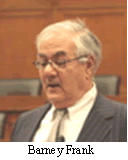 Republican opposition, the House approved H.R. 4173: The Wall Street Reform and Consumer Protection Act of 2009. The vote was 223-202, with not a single Republican voting in favor and 27 Democrats voting No. Two Republicans who were present did not vote.
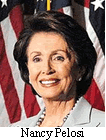 Pelosi at a press conference following the bill’s passage. "The legislation will finally protect Main Street from the worst of Wall Street."


