World government by the bankers, for the bankers was the goal from the beginning. They created the problem for a reason, and they had the solution ready all along. Obama is just another stooge to help them do their dirty work while he and his wife party the nights away kissing the feet of world leaders and European Monarchy. He will go down in history as the usurper who finished what Woodrow Wilson started in 1913 with the Federal Reserve Act ...handing our nation and our freedom over to the world bankers and their world government while the people of this nation and their politically correct apathy allowed it to happen.
Tuesday, April 7, 2009
Warning: Never Swallow Regular Toothpaste
Professional Perspectives: Fluoride in Tap Water
In this video, dentist Bill Osmunson explains why he is now concerned about fluoride and water fluoridation.
Dr. Mercola's Comments:
Fluoride, one of the most consumed drugs in the United States, is deliberately added to about two-thirds of U.S. public water supplies, theoretically to reduce tooth decay, even though there’s no scientifically-valid evidence proving either safety or effectiveness.
In this video, Dr. Bill Osmunson, general and cosmetic dentist for 30 years, talks about how he came to change his mind about water fluoridation, which he promoted aggressively for the first 25 years of his practice. He thought he saw the benefits, but it wasn’t until he actually reviewed the information for himself that he began to realize that fluoridation is a serious problem.
Why Does Toothpaste Carry a Warning But Fluoridated Water Does Not?
One of the first things he did was look at a tube of toothpaste, which clearly carries the warning: “Do not swallow,” and “in case of accidental ingestion, contact the poison control center.”
The amount of fluoride they’re talking about is a quarter milligram of fluoride, contained in a pea size amount of toothpaste.
But here is the kicker, This is the same amount of fluoride you find in 8 oz of water. Yet toothpaste carries a “Do not swallow” warning, whereas you’re typically told to drink eight 8oz glasses of water each day, without any concern for the amount of fluoride you will ingest.
One of Dr. Osmunson’s main concerns is water fluoridation for infants. The American Dental Association (ADA) and the Center for Disease Control (CDC) recommend that infants NOT receive fluoridated water for drinking, nor for making their formula, as fluoridated water contains 250 times more fluoride than mother’s milk.
“We shouldn’t fluoridate water and harm our most vulnerable,” he says.
Personally, I also strongly advise you do not give your children fluoridated water.
Unfortunately, the only way to ensure your water is pure enough to drink is by installing a good water filtration system in your house, such as a reverse osmosis filter that can filter out fluoride and other dangerous water contaminants like disinfection byproducts (DBPs). Bottled water also typically contains fluoride, even though it’s not stated on the label.
Dental Fluorosis – A Clear Sign of Excessive Fluoride Intake
The next thing Dr. Osmunson looked at was dental fluorosis. These are the white and brown spots on your teeth. The only thing that causes dental fluorosis is fluoride – typically due to ingesting too much fluoride during your developing years, from birth to about 8 years of age. According to the CDC, about one third of children and adolescents 6 to 19 years have enamel fluorosis on their teeth.
When dental fluorosis occurs, it can be an indication that the rest of your body has been exposed to too much fluoride also, such as your bones and the rest of your organs, including your brain.
So, are there actual benefits of water fluoridation?
Depending on the source, water fluoridation has been said to reduce tooth decay by anywhere from 20 to 80 percent. But when you compare the statistics between different countries, you see that no matter whether they fluoridate their water or not, tooth decay has steadily been reduced by the same amount.
Likewise, when you compare states in the U.S., you find that increased amounts of fluoride in the drinking water make no difference. We have the same amount of good healthy teeth, regardless of water fluoridation.
So, if there’s no benefit, WHY are we fluoridating?
Why Do We Fluoridate Drinking Water if It’s Not Healthy?
The evidence points to it being little more than a well-orchestrated PR stunt to aid an industry in trouble – a fascinating story in and of itself, as described so well in Christopher Bryson’s book The Fluoride Deception and in one of the best web sites on this topic, Fluoride Action Network (FAN).
Other pro-fluoride advocates go so far as to try to make you believe that fluoride is a nutrient that naturally helps build strong teeth and bones. One such example is the Directive 2002/46/EC of the European Parliament and the Council, which lists “fluoride” as one of only 28 vitamins and minerals permissible for sale for human consumption within the European Union.
But let’s make this point clear: fluoride is NOT an essential nutrient. The fluoride added to your drinking water is in fact a chemical waste product! It is NOT something you should use as a supplement to your diet.
There are plenty of studies showing the dangers of fluoride to your health, such as:
|
|
|
|
|
|
|
|
|
|
|
|
|
|
|
|
|
|
http://articles.mercola.com/sites/articles/archive/2009/04/07/Warning-Never-Swallow-Regular-Toothpaste.aspxThe Key to Healthy Teeth is in Your Diet
If you’re wondering how to keep your teeth healthy, remember that fluoride was never the answer in the first place. Instead, look to your diet for naturally healthy teeth. In fact, most people whose diet includes very little sugar and few processed foods have very low rates of tooth decay.
Limiting, or eliminating sugar, and avoiding processed foods -- along with regular cleanings with your natural dentist -- will ensure that your teeth stay healthy naturally.
What You Can Do to Help Eliminate Water Fluoridation
Dr. Osmunson suggests you talk to your dentist and health care provider about water fluoridation. For example, ask them if they’ve seen the National Academy of Sciences report on fluoridation. You can help educate them by giving them information they may not have on water fluoridation and excess fluoridation exposure.
He also suggests that professional health care providers and dentists take the time to look at both sides of the issue. If you are a professional in the field, you may also want to add your name to the online Professional Statement at www.FluorideAlert.org. As of April 2009, 2,221 medical and environmental health professionals have signed this statement, calling for an end to water fluoridation.
Related Links:
Monday, April 6, 2009
Never in the field of human history has so much been taken from so many by so few
SOTT.net
Sat, 04 Apr 2009 19:39 UTC
The week ended with the G20 summit and more importantly with the G20 final communique which promises a dark future; for wrapped in the cloth of "free trade", a trillion dollars for the IMF and "trade finance" and the regulation of banker's pay is the formation of a global overseer, the Financial Stability Board and the announcement that "the era of banking secrecy (which means privacy) is over."
There is a great deal in the G20 final communique and what with the general goings on this coming week with the NATO summit following the G20 and US President Obama's visit to Ankara that we will be providing an analysis of the G20 summit and its context during the course of next week.
This week we take a closer look at who really benefited from the AIG bailout and the true size of the US governments financial commitments to the "Global Financial Crisis". With apologies to Winston Churchill and the fighter pilots of the Battle of Britain:-
Never in the field of human history has so much been taken from so many by so fewMarkets
Since Tuesday, March 31st was the end of the first quarter of 2009, let's look at the quarterly numbers. The dollar gained ground in the first quarter, gaining 5% on the euro and 7.6% on the yen. The major world stock indices fell during the first quarter, with the Dow losing almost 16%, the FTSE 14%, the DAX 18%, the NIKKEI 8.5%, and the Hang Seng down 9.75%. The Brazilian BOVESPA was up 1.7%. Gold was up 5.5% in dollars and 11% in euros. Oil rose 7% in dollars and 12.6% in euros. [This week's and the quarter's data tables are at the end of this article].
For the week and two days since Friday, March 20th, world stock indices were up, mostly in the 2% to 6% range, as was the dollar (up 2.5% against the euro and 3% against the yen). Gold fell 3% and oil fell almost 5% in dollars.
Here are some charts following currency and commodity prices since January 2005. Note that oil prices and the dollar/euro exchange rates are very close to what they were in the beginning of '05. Gold, however, has more than doubled despite the immense downward pressure exerted by the world gold cartel as it seeks to maintain a cap on the price of gold and silver.
Reserve Currency
Some confusion was generated, deliberately or not, last week when U.S. Treasury Secretary Geithner told the Chinese that he was "quite open" to a new reserve currency besides the dollar.
The dollar plunged instantly against the euro, yen, and sterling as the comments flashed across trading screens. David Bloom, currency chief at HSBC, said the apparent policy shift amounts to an earthquake in geo-finance.What are we to make of this? As the Financial Times wrote, changing reserve currencies is quite an undertaking which ultimately hangs on "sovereign credibility and power":-
"The mere fact that the US Treasury Secretary is even entertaining thoughts that the dollar may cease being the anchor of the global monetary system has caused consternation," he said.
Mr Geithner later qualified his remarks, insisting that the dollar would remain the "world's dominant reserve currency ... for a long period of time" but the seeds of doubt have been sown.
The markets appear baffled by the confused statements emanating from Washington. President Barack Obama told a new conference hours earlier that there was no threat to the reserve status of the dollar.
Global reserve currencyWhat the Financial Times seems to be avoiding is the obvious fact that the idea of a new international reserve currency means that it will be supra-national and the "power' and "credibility" will be delivered by a supra-national body or bodies. Such a body or group of bodies would have the effect of being a World Government.
Athenian owls, Roman denarii, British sovereigns, US dollars. There have been many pseudo reserve currencies down the ages. Now the governor of the People's Bank of China has called for a new global currency "disconnected from individual nations". Russia, too, wants to move away from a world dominated by the dollar. Kazakh president Nursultan Nazarbayev suggests such a currency could be called the acmetal - an amalgam of "acme" and "capital".
But is there a case for one? In theory, yes. (Although no one was banging the table for change when emerging growth rates were still being powered by deliberately undervalued domestic currencies.) The reserve currency status of the dollar helped to create nasty global imbalances - one of the main culprits of the current downturn. As China, for example, recycled export earnings back into dollar-denominated assets, the US could happily run profligate trade deficits with impunity. That helped push up the price of US assets, particularly house prices.
Now surplus countries are stuck. They cannot diversify fast enough and a rapid sell down of US assets would destroy their portfolios. Not only that, global central banks holding about two thirds of their reserves in dollars are hostage to the Obama administration. Unsurprisingly, huge budget deficits and the Federal Reserve's leap into quantitative easing have foreigners fretting over the longer term health of the dollar.
Theory is one thing, however. In reality, currencies live and breathe more than just short-term economic air. The two other life forces for a reserve currency are sovereign credibility and power. China, Russia and India simply do not have long enough economic track records to justify backing a reserve currency. Find a single investor in this crisis that has panicked out of dollars into roubles. Of course, if China one day emerges as the dominant economic and military power, the status quo will change. Until then, investors cannot be rushed.
One thing is clear, if destroying the dollar moves the Plan to concentrate control of the world into fewer hands, among which will be a handful of megabanks, it will happen; conversely, if the Plan calls for a strong dollar, that will happen. For the moment it appears that the confusion caused by Geithner's and China's statements was intended; or, as we said in our introduction, perhaps Geithner forgot which Act of the play we are in.
Gold
Once more we see gold being manipulated, this time ahead of the G20 summit being sold down aggressively to the $900 mark. At the summit we heard the same old tired story of IMF gold being sold into the physical market; a story that just keeps getting trotted out whenever the physical market looks likely to burst through the downward pressure exerted through the futures market.
Seeking Alpha has come across an interesting change in the futures market:-
NYSE Runs Out of Gold Bars: What Happens Next?On top of this or perhaps because of it, COMEX has announced that it is launching a new E-Mini future contracts on gold and silver on April 19th covering, yes you guessed it, 1kg of gold and 1000oz of silver for which they is absolutely no mechanism for physical delivery. With no mechanism for delivery and only cash settlement the floodgates of market manipulation through naked short selling will be opened. Theodore Butler summed these new contracts up perfectly:-
The NYSE-Liffe futures exchange has, it seems, run out of 1 kg bars of gold. Futures markets, like NYSE-Liffe and COMEX, try hard to maintain the fiction that they will deliver physical gold, [o]n completion of executed contracts. Indeed, to prevent fraud, U.S. law requires clearing members to keep a stockpile, of one kind or another, consisting of a minimum of 90% of metal. Up until October, 2008, it didn't matter. Only about 1% of long buyers of paper gold futures contracts typically took delivery. Now, the situation is very different. Demand has surged and, it appears, one major futures exchange, NYSE-Liffe, and by extension, the COMEX gold warehouses it shares with its larger cousin, are unable to meet the requirements of their contracts, vis-a-vis, delivery of 1 kg. bars.
As of December 31, 2008, the NYSE-Liffe mini-gold (YG) contract specifications were changed to read, in pertinent part, as follows:33.2 fine troy ounces (+10%), no less than .995 fineness. Seller's discretion delivery of one vault receipt representing one bar or one Warehouse Depository Receipt (WDR) representing either 1/3 interest in one full size gold NYSE Liffe vault receipt or full interest in a NYSE Liffe Mini Gold vault receipt. Delivered to exchange approved vaults by exchange approved carriers.But, before that, on August 26, 2008, it read as follows:33.2 troy ounces (±5%) of refined gold, assaying not less than .995 fineness, contained in no more than one bar.In summary, there is now so much demand for delivery of the mini-contracts that the exchange can no longer deliver 1 kg bars. When the wording was changed, a flurry of complaints resulted. Technically, in my opinion, if you bought a mini futures contract from an NYSE-Liffe clearing member, prior to December 31st, you could bind them to their legal contract with you, and force them to either deliver the 1 kg bar, or pay for you to obtain it on the open spot market. Based upon the original wording, NYSE-Liffe and its clearing members are legally obligated to deliver that 1 kg bar per contract, whether they want to or not, and regardless of the internal rules of the exchange. Whether anyone will force compliance, however, is an open question.
Let me be as clear as I can - because these new contracts do not contain actual metal delivery clauses, they are, in my opinion, fraudulent contracts. The CME should be ashamed of itself for introducing them, and the CFTC disgraces itself (again) for not preventing their introduction.With ever greater quantitative easing and the resulting inflationary pressures we can only wonder how long the blatant rigging of the bullion market can continue.
Monetary Policy, Inflation, Stimulus
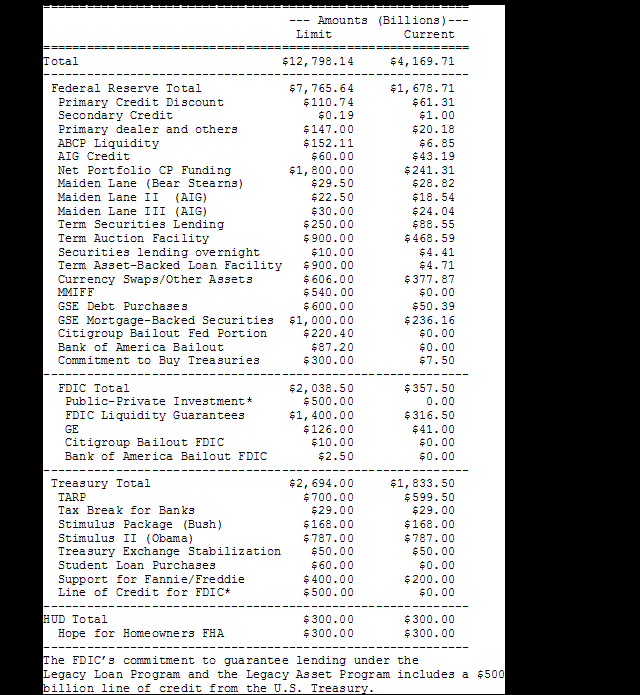
If you are trying to keep score, according to Bloomberg, the U.S. has spent or committed almost $13 trillion on bailouts, rescues, and stimuli. Note the attitude displayed of the bankers and economist in the article below and ask yourself, with respect to each of them, if this is the attitude of a person who really understands what is going on, who hasn't a clue or is in on the scam:-
Financial Rescue Nears GDP as Pledges Top $12.8 TrillionThe Real Economy
The U.S. government and the Federal Reserve have spent, lent or committed $12.8 trillion, an amount that approaches the value of everything produced in the country last year, to stem the longest recession since the 1930s.
New pledges from the Fed, the Treasury Department and the Federal Deposit Insurance Corp. include $1 trillion for the Public-Private Investment Program, designed to help investors buy distressed loans and other assets from U.S. banks. The money works out to $42,105 for every man, woman and child in the U.S. and 14 times the $899.8 billion of currency in circulation. The nation's gross domestic product was $14.2 trillion in 2008.
President Barack Obama and Treasury Secretary Timothy Geithner met with the chief executives of the nation's 12 biggest banks on March 27 at the White House to enlist their support to thaw a 20-month freeze in bank lending.
"The president and Treasury Secretary Geithner have said they will do what it takes," Goldman Sachs Group Inc. Chief Executive Officer Lloyd Blankfein said after the meeting. "If it is enough, that will be great. If it is not enough, they will have to do more."
Commitments include a $500 billion line of credit to the FDIC from the government's coffers that will enable the agency to guarantee as much as $2 trillion worth of debt for participants in the Term Asset-Backed Lending Facility and the Public-Private Investment Program. FDIC Chairman Sheila Bair warned that the insurance fund to protect customer deposits at U.S. banks could dry up because of bank failures.
'Within an Eyelash'
The combined commitment has increased by 73 percent since November, when Bloomberg first estimated the funding, loans and guarantees at $7.4 trillion.
"The comparison to GDP serves the useful purpose of underscoring how extraordinary the efforts have been to stabilize the credit markets," said Dana Johnson, chief economist for Comerica Bank in Dallas.
"Everything the Fed, the FDIC and the Treasury do doesn't always work out right but back in October we came within an eyelash of having a truly horrible collapse of our financial system, said Johnson, a former Fed senior economist. "They used their creativity to help the worst-case scenario from unfolding and I'm awfully glad they did it."
Federal Reserve officials project the economy will keep shrinking until at least mid-year, which would mark the longest U.S. recession since the Great Depression.
The following table details how the Fed and the government have committed the money on behalf of American taxpayers over the past 20 months, according to data compiled by Bloomberg.
The recession in the UK was worse in the 4th quarter of 2008 than thought due to sharper decreases in consumer spending and construction.
In the United States, home prices fell 20% from January 2008 to January 2009 in the 20-city index published by Case Shiller. The city of Flint, Michigan, made famous by Michael Moore's classic documentary, Roger and Me, is actually considering shutting down parts of the city:-
Look in any direction from Bianca Bates' north Flint home, and you'll see graffiti-covered siding, boarded-up windows and overgrown lotsUS banking rescue
About half of the homes on her block are burned out or vacant magnets for drug dealers and squatters. It isn't where she thought she'd end up, but it's all she can afford to rent.
"It's a dangerous place to live," said Bates, 21, who lives on East Russell Avenue. "Everywhere you look, these houses are empty around here."
© Ryan Garza/The Flint Journal
The view through an abandoned house's broken window looks out on a boarded-up house across the street on East Russell Avenue in Flint.
Property abandonment is getting so bad in Flint that some in government are talking about an extreme measure that was once unthinkable -- shutting down portions of the city, officially abandoning them and cutting off police and fire service.
Temporary Mayor Michael Brown made the off-the-cuff suggestion Friday in response to a question at a Rotary Club of Flint luncheon about the thousands of empty houses in Flint.
Brown said that as more people abandon homes, eating away at the city's tax base and creating more blight, the city might need to examine "shutting down quadrants of the city where we (wouldn't) provide services."
He did not define what that could mean -- bulldozing abandoned areas, simply leaving the vacant homes to rot or some other idea entirely.
On Monday, a city spokesman downplayed Brown's comments.
Just in case there was any doubt who is running the United States it was wiped away as President Obama had a "very pleasant" meeting with the big bankers then, a week later, fired the head of General Motors and condemned GM and Chrysler to bankruptcy. The auto companies actually make something useful and provide salaries, pensions and healthcare to lots of working and retired people while the banks have been shown to be nothing more than immense private casinos.
There is no doubt that the economic system needs to be restructured, banks and auto companies included, but to continue bailing banks out with essentially no conditionality other than a few figs leaves to placate the public while condemning the millions of people associated with the auto industry is reprehensible. Maybe the auto companies should have donated more money to the campaigns of the President and members of Congress.
Although after the meeting with the bankers, there was a show of some dissatisfaction, that was only for public display. Joe Kishore:-
Every aspect of the administration's economic policy caters to the interests of the financial elite, of which the president is merely a mouthpiece. The private meeting at the White House had the air of a conspiracy against the public, a gathering to discuss carving up state resources in order to hand them over to the banks and major investors.The discussions about the auto industry revolved around how best to deny healthcare and pensions obligations to retired workers. When, after a massive giveaway to the banks, Obama had to appear tough against the corporate elite, he took on the politically easy target of the auto companies. Of course the auto companies are no angels having connived to suppress fuel-efficient and alternative fuel vehicles for decades and building their products on the basis of them being consumables rather than long term assets. But they are one of the few remaining pillars of manufacturing in the US with millions of livelihoods depending upon them. It takes years to retool auto plants so decisions taken now will be hard to reverse; which may be exactly the point of course.
Joe Kishore again:-
As the administration works with Wall Street to make the banks - and the personal portfolios of the bankers - whole, Obama is preparing a massive attack on the working class. During his press conference, the president repeatedly stressed his determination to tackle "high health care costs" and implement "Entitlement reform" - i.e., cuts in Social Security, Medicare and Medicaid.The Geithner plan to take devote $1.2 trillion to take "toxic" assets off bank balance sheets is breathtaking in its criminal simplicity: use taxpayer money to pay banks for their worthless assets, leaving the banks to run their profitable businesses and keep the money they stole for over a decade. The scheme is headlined at $1.2 trillion which according to Douglas Elliot at the Brookings Institute is the sum total of toxic mortgage assets held by US banks. Not only that, but they get to run one more scam.
As the question of restrictions on executive bonuses is dropped, Obama repeated on Thursday his insistence that any aid to the auto industry be conditioned on further job and wage cuts from autoworkers. In an online town hall meeting, the president said that the auto industry will have to "make some pretty drastic changes. And some of those are still going to be painful."
The policy of the administration is to ensure that this "pain" is born entirely by the working class, while the looting of public assets by the financial elite continues.
The Free Market, Financial Style: How the Scam Works
Newspaper reports seem surprised at how high banks are bidding for the junk mortgages that Treasury Secretary Geithner is now bidding for, having mobilized the FDIC and Fed to transfer yet more public funds to the banks. Bank stocks are soaring - thereby bidding up the Dow Jones Industrial Average, as if the "financial industry" really were part of the industrial economy.
Why are the very worst offenders - Bank of America (now owner of the Countrywide crooks) and Citibank the largest buyers? As the worst abusers and packagers of CDOs, shouldn't they be in the best position to see how worthless their junk mortgages are?
That turns out to be the key! Obviously, the government has failed to protect itself - deliberately, intentionally failed to do so - in order to let the banks pull off the following scam.
Suppose a bank is sitting on a $10 million package of collateralized debt obligations (CDOs) that was put together by, say, Countrywide out of junk mortgages. Given the high proportion of fraud (and a recent Fitch study found that every package it examined was rife with financial fraud), this package may be worth at most only $2 million as defaults loom on Alt-A "liars' loan" mortgages and sub-prime mortgages where the mortgage brokers also have lied in filling out the forms for hapless borrowers or witting operators taking out mortgages at far more than properties were worth and pocketing the excess.
The bank now offers $3 million to buy back this mortgage. What the hell, the more they bid, the more they get from the government. So why not bid $5 million. (In practice, friendly banks may bid for each other's junk CDOs.) The government - that is, the hapless FDIC - puts up 85 per cent of $5 million to buy this - namely, $4,250,000. The bank only needs to put up 15 per cent - namely, $750,000.
Here's the rip-off as I see it. For an outlay of $750,000, the bank rids its books of a mortgage worth $2 million, for which it receives $4,250,000. It gets twice as much as the junk is worth.
The more the banks holding junk mortgages pay for this toxic waste, the more the government will pay as part of its 85 per cent. So the strategy is to overpay, overpay, and overpay. Paying 15 per cent is a small price to pay for getting the government to put in 85 per cent to take the most toxic waste off your books.
The free market at work, financial style.
Wanted for fiscal crimes against humanity: Henry 'Hank' Paulson, former Treasury Secretary and CEO of Goldman Sachs
AIG and Goldman Sachs
Talking of scams and heists, as we discussed last week, the grandstanding in the US Congress over AIG bonuses was clearly designed for the media spin machine while deftly keeping the real secrets of the AIG bailout out of the public mind. As Megan Slack at Alternet points out, the Merrill Lynch "performance related" bonuses were 22 times the contractual "retention" bonuses at AIG. The Merrill bonuses were also 36.2% of the TARP monies granted to Merrill and Bank of America, it's new parent. We may have missed it of course but we didn't notice the roof of Congress being blown off in uproar and hastily cobbled tax Bills being rushed through at the Merrill pay outs. It is therefore appropriate to take a close look at where some of the AIG bailout money went.
Last week we explored how AIG Financial Products (AIGFP) acted as final insurer for an array of Credit Default Swaps and other unregulated derivatives in a manner that meant that when the value of the insured securities dropped AIGFP was required to provide cash collateral. AIGFP was also heavily involved in the Stock Lending business which included similar arrangements for AIGFP to provide cash collateral in the event of the value of stocks falling. On March 15th AIG disclosed who its counterparties were and how much money they had received under these collateral and other arrangements between September 16th 2008 and December 31st 2008.
Setting aside the sums paid to US States, we find that $22.4 billion was paid out directly as collateral against Credit Default Swaps; $27.1 billion indirectly, via a company set up to manage parts of the AIGFP portfolio called Maiden Lane III, as collateral against Credit Default Swaps; and $43 billion to Securities Lending Counterparties, all to banks.
The individual beneficiaries of note were; Goldman Sachs - $12.9 billion, Bank of America/Merrill Lynch - $ 12.4 billion, Societe Generale $11.9 billion, Deutsche Bank - $11.8 billion, Barclays - $8.5 billion, UBS - $ 5 billion and BNP Paribas - $4.9 billion.
Of course complete silence over where all this money went was impossible. Initial calls for investigation came from those who champion global markets when it suits the US and then suddenly find themselves violently opposed to global markets when it doesn't suit. The initial wave of protectionist rhetoric focused on the fact that foreigners were reaping the benefits of the AIG bailout but this has now had to be broadened to include Goldman Sachs.
AIG Payments to Banks Should Be Probed, Lawmakers SaySo in summary we have a group of international banks who have made billions from the trading of securities, often through the deliberate and careful manipulation of prudential and legal regulation, finding that the value of their portfolios was severely reduced due to a mixture of factors including the simple fact that many of the securities were in fact useless junk. Other securities may not be useless junk but nobody can really tell as they depend upon ordinary people paying their mortgages and companies paying their loan commitments over time.
Lawmakers called for a federal probe into whether banks including Goldman Sachs Group Inc. received more funds than necessary from the bailout of American International Group Inc.
"We would like to know if the AIG counterparty payments, as made, were in the best interests of the taxpayers," said 27 members of Congress led by Elijah Cummings, a Democrat from Maryland, in a letter dated yesterday to Neil Barofsky, inspector general for the Troubled Asset Relief Program. Banks got about $50 billion in payments tied to credit-default swaps.
The demand reflects widening frustration among lawmakers with the rising cost of AIG's bailout, now valued at $182.5 billion. The U.S. has propped up New York-based AIG four times since September after a cash shortage left the insurer unable to back up protection sold to banks on their fixed-income holdings. The lawmakers asked why banks weren't asked to take some losses to help stabilize AIG and the financial system.
"Was any attempt made to renegotiate and close out these contracts with 'haircuts?'" the letter asked. "If not, why not?"
The query from the lawmakers concerns payments made to unwind some of AIG's credit-default swaps, contracts similar to insurance that pay investors if bonds don't pay as promised. AIG sold swaps to more than 20 U.S. and foreign banks.
Imposing 'Haircuts'
After AIG was rescued by the U.S. from collapse last year, banks that bought credit-default swaps got $22.4 billion in collateral and $27.1 billion in payments to retire the contracts, the insurer said earlier this month. Goldman Sachs, Deutsche Bank AG and Societe Generale SA were among the largest recipients. The letter asked whether holders received 100 cents on the dollar for their securities, a sum they wouldn't be entitled to get unless their bonds actually defaulted...
Under the law, the banks would have to sit out the crisis and see what could be recovered over time. Their insurer is bankrupt and cannot be relied upon as it is insolvent and must therefore be wound up. Whether they recover 5 cents on the dollar or more or less will be a matter of time and a great deal of hassle. If this was the insurance on our homes, our assets or our life savings this is what would happen.
But the law does not apply to the financial elite; other rules apply to them.
Before moving on let's cast our minds back to September 2008 when Lehman had collapsed, AIG was rescued and the New York Times ran this story:-
Behind Insurer's Crisis, Blind Eye to a Web of RiskAs FTAlphaville put it:-
Although it was not widely known, Goldman, a Wall Street stalwart that had seemed immune to its rivals' woes, was A.I.G.'s largest trading partner, according to six people close to the insurer who requested anonymity because of confidentiality agreements. A collapse of the insurer threatened to leave a hole of as much as $20 billion in Goldman's side, several of these people said.
Days later, federal officials, who had let Lehman die and initially balked at tossing a lifeline to A.I.G., ended up bailing out the insurer for $85 billion.
Their message was simple: Lehman was expendable. But if A.I.G. unspooled, so could some of the mightiest enterprises in the world.
A Goldman spokesman said in an interview that the firm was never imperiled by A.I.G.'s troubles and that Mr. Blankfein participated in the Fed discussions to safeguard the entire financial system, not his firm's own interests.
... which caused something of a furore.Now, being humble souls we at Sott.net may not have a proper understanding of the value of money but doesn't $12.9 billion seem like a material amount of money to you?
Goldman strenuously and very publicly denied the gist of the allegation. So aggressive was their rebuttal, in fact, that the wires even wrote up separate stories on it. Here's Reuters:Goldman Sachs Group Inc rejected as "seriously misleading" a published report on Sunday that said the Wall Street bank had as much as $20 billion of exposure to the troubled insurance giant American International Group Inc.
Lucas van Praag, a Goldman spokesman, on Sunday said the Times article was wrong to suggest that Goldman had reason to be concerned about AIG's problems.
"Although we have said many times on the record that our exposure to AIG was, and is, not material, the reporter chose to pursue a story line which suggests, by innuendo, that is not the case," he said in an e-mailed statement.
"For the avoidance of doubt, our exposure to AIG is offset by collateral and hedges and is not material to Goldman Sachs in any way," he continued. "The conclusions about our interests that readers of the New York Times article are invited to reach are seriously misleading."
At the end of 2008 Goldman Sachs had $42.7 billion of Tangible Common Equity (TCE - the type of core capital that the Obama administration is focused on), should AIG not have paid out that $12.9 billion the hit for Goldman would have been taken against this. Such a significant hit to a bank's capital in the current environment might have been catastrophic. What Goldman has collected between the end of 2008 and now under the ever increasing AIG bailout is anybody's guess.
Not only is $12.9 billion a material amount of money and banking capital but the last time one of us did a stock exchange exam it was a criminal offensive to make false or misleading statements in relation to a public company, especially if the person making those statements was an officer of the company. So it seems to us that members of the US Congress instead of grandstanding for punitive taxes against AIGFP executives should be demanding criminal probes of Goldman Sachs and its current and former employees. This is of course not going to happen because Goldman Sachs former employees run the US government. What an excellent example of the corporate controlled state, otherwise known as Fascism.
To believe that the financial crisis is a result of mistakes or stupidity would be naïve. Larry Summers, Timothy Geithner and their colleagues are not stupid. Nor, more importantly, are the faceless people giving them their orders. The mess the whole world is in is a direct and completely foreseeable result of the legal and regulatory framework put in place with the commencement of the repeal of the Glass-Steagall Act in 1999. Dave Lindorff dug up quotes from the 1999 article about the repeal in the New York Times:
A Financial History Lesson: These Are the People We Expect to Fix Things?The New York Times article did say that
George Santayana once famously said, "Those who cannot learn from history are doomed to repeat it." But what about those who don't just ignore history, but who hire and take counsel from those who committed historic follies in the past?
Back in November 1999, Congress passed legislation pushed by then Sen. Phil Gramm (R-TX), rescinding the Depression-era Glass-Steagall Act. The measure, backed by the Clinton administration, and overwhelmingly passed by the Senate (90-8) and the House (362-57), opened the way for banks to merge with investment banks and insurance companies, and led directly to the current financial cataclysm.
A report on that Congressional action written by reporter Stephen Labaton and published in the New York Times on Nov. 5, 1999 under the headline "Congress Passes Wide-Ranging Bill Easing Bank Laws," includes some remarkable quotes from key players in that sellout to the financial sector.
Here's Larry Summers, a chief architect of the current financial industry multi-trillion-dollar bailout giveaway being orchestrated by the Obama administration, where he serves as director of President Obama's National Economic Council:-''Today Congress voted to update the rules that have governed financial services since the Great Depression and replace them with a system for the 21st century. This historic legislation will better enable American companies to compete in the new economy.''And here's what Sen. Charles Schumer (D-NY), awash in Financial industry campaign donations but currently in high dudgeon over the Wall Street's bonus payments to executives, speaking about the '99 measure eliminating Glass-Steagall:-''If we don't pass this bill, we could find London or Frankfurt or years down the road Shanghai becoming the financial capital of the world. There are many reasons for this bill, but first and foremost is to ensure that U.S. financial firms remain competitive."The article quotes the Clinton administration and Summers' Treasury Department as predicting that revoking Glass-Steagall and permitting banks to expand into investment banking and insurance would save consumers "$18 billion a year" through economies of scale - a figure that seems rather quaint as taxpayers now pony up trillions of dollars to rescue those same institutions. (The article notes that critics of deregulation argued that even those paltry savings, probably overstated, would flow to financial sector investors, not to consumers.)
The old Times clip (brought to my attention by alert veteran radical writer and activist Bert Schultz of Philadelphia), does highlight a couple of prophetic heroes, too.
Sen. Byron Dorgan (D-ND), one of seven Senate Democrats who voted against revoking Glass-Steagall, said:-"I think we will look back in 10 years' time and say we should not have done this but we did because we forgot the lessons of the past, and that that which is true in the 1930's is true in 2010. I wasn't around during the 1930's or the debate over Glass-Steagall. But I was here in the early 1980's when it was decided to allow the expansion of savings and loans. We have now decided in the name of modernization to forget the lessons of the past, of safety and of soundness.''And then there's the late Sen. Paul Wellstone (D-MN), who died in a plane crash during his campaign for re-election in 2002. Congress, he said, seemed:-"...determined to unlearn the lessons from our past mistakes. Scores of banks failed in the Great Depression as a result of unsound banking practices, and their failure only deepened the crisis. Glass-Steagall was intended to protect our financial system by insulating commercial banking from other forms of risk. It was one of several stabilizers designed to keep a similar tragedy from recurring. Now Congress is about to repeal that economic stabilizer without putting any comparable safeguard in its place.''For the record, also voting against Glass-Steagall repeal in the Senate were lone Republican Richard Shelby of Alabama, and six other Democrats: Barbara Boxer (CA), Richard Bryan (NV), Russ Feingold (WI), Tom Harkin (IO), and Barbara Mikulski (MD). 51 Democrats, 5 Republicans and 1 independent voted against the measure in the House.
Treasury Secretary Tim Geithner, a key player in the current bailout scheme, isn't mentioned in the Times article about Glass-Steagall, but at the time was a protégé of Summers, working as undersecretary of the treasury for international affairs.
While they are thankfully well out of the loop in the current scramble in Washington to both end the reverse the economic collapse and try and help financial companies and financiers profit from it, it's worth reading too in this 10-year-old clip what Phil Gram and then Sen. Bob Kerry (D-NB and now embattled president of the New School in New York City) had to say about ending Glass-Steagall.
Sen. Gramm:-'The world changes, and we have to change with it. We have a new century coming, and we have an opportunity to dominate that century the same way we dominated this century. Glass-Steagall, in the midst of the Great Depression, came at a time when the thinking was that the government was the answer. In this era of economic prosperity, we have decided that freedom is the answer.''And then Sen. [Bob] Kerry, with a line that should probably be etched someday on his tombstone as his most memorable line:-"The concerns that we will have a meltdown like 1929 are dramatically overblown."
The decision to repeal the Glass-Steagall Act of 1933 provoked dire warnings from a handful of dissenters that the deregulation of Wall Street would someday wreak havoc on the nation's financial system. The original idea behind Glass-Steagall was that separation between bankers and brokers would reduce the potential conflicts of interest that were thought to have contributed to the speculative stock frenzy before the Depression.As always, we would all have been served better if the "handful of dissenters" had been listened to. However, we believe that the policymakers quoted in favor of the Act did realize what the consequences would be; they knew that it would open the flood gates of financial speculation known in banking as "proprietary trading"; their subsequent actions in allowing excessive bank leverage, keeping credit derivatives deliberately unregulated and emasculating the SEC and other regulators confirms this. They were lying to the public and they were conducting a scam in favour of the financial elite and themselves.
Under a Guise
With its President, Nicholas Sarkozy threatening to boycott the G20 summit, a threat so ridiculous in its hollowness that it was clearly stage-managed for the media spin machine, France is presented as being at the forefront of the push for tougher regulation and in the battle against 'tax havens'.
As we have commented before, there is nothing in the nature of this manufactured crisis that can be laid at the door of 'tax havens' yet Sarkozy makes it one of his "red line" principles upon which he is prepared to sacrifice the entire G20 summit. For Sarkozy this is a "red line" issue; for us this is a very large red flag for it seems that there are global moves afoot to establish totalitarianism. France and Germany are championing the destruction of financial privacy under the guise of fighting tax evasion; the EU as a whole is championing the replacement of parents with the state in the minds and lives of children; the UK is championing the destruction of privacy in general in its mania for video, email, postal and telephone surveillance under the guise of fighting terrorism; Australia is championing wholesale national censorship of the internet (the last free and open medium of exchange) under the guise of fighting terrorism and pedophilia; the US is championing the violence of the police state and total population control with its heavy use of Tasers, establishment of internment camps, "in-your-face policing" and "papers please" control that would make the Gestapo proud (in fact, if one traces the real origins of the CIA it IS making the Gestapo proud for that is the origin of much of the CIA); while Israel perfects the art of apartheid and genocide while portraying itself as the ultimate victim.
Each of these planks of the totalitarian future is being "perfected" and normalized in one country or region and then slowly introduced elsewhere. So while people, including yourself perhaps, may sit back and nod sagely that it is important to crush tax havens and prevent those dreadful tax evaders from evading their legal obligations remember that they are supporting a key part of the totalitarian future.
Sarkozy got what he wanted on tax havens in text that should be chilling for us all:-
..to take action against non-cooperative jurisdictions, including tax havens. We stand ready to deploy sanctions to protect our public finances and financial systems. The era of banking secrecy is over. We note that the OECD has today published a list of countries assessed by the Global Forum against the international standard for exchange of tax information;In case it needs repeating, we urge you to truly understand what is meant by "non-cooperation" and the threat of sanctions. Remember that Iraq and Afghanistan are both sovereign nations that did not cooperate. Iraq was subject to sanctions that killed an estimated 500,000 children under 5 over ten years. Iran is a sovereign nation that is deemed by its enemies to not be cooperating and is now under a throttling regime of sanctions that go mostly unreported in the mainstream media.
There is a new world order being implemented both right in front of us and in the shadows; those that resist are termed "non-cooperative" and will have the full weight of propaganda turned against them such that should they continue to resist then sanctions will be imposed. For nations that rely on international finance for their survival, sanctions will no doubt bring them to heel; for other nations more brutal measures may be required, as in Iraq and Afghanistan. Every move will be justified using the mainstream media propaganda machine; the aggressors will be portrayed, as always, as seeking to right the wrongs of the world; all the while the dark suppressive blanket of totalitarianism is drawn further over us all.
The power of the nations of the G20 is essentially absolute so once again we see history marching forward forgetting the lessons of its past and in particular the old adage that "Power Corrupts and Absolute Power Corrupts Absolutely".
| Previous close | March 31st close | Change | % change | |
|---|---|---|---|---|
| Gold (USD) | 952.90 | 925.00 | 27.90 | 2.93% |
| Gold (EUR) | 701.80 | 698.06 | 3.74 | 0.53% |
| Oil (USD) | 52.10 | 49.66 | 2.44 | 4.68% |
| Oil (EUR) | 38.37 | 37.48 | 0.89 | 2.33% |
| Gold:Oil | 18.29 | 18.63 | 0.34 | 1.84% |
| USD / EUR | 0.7365 / 1.3578 | 0.7547 / 1.3251 | 0.0182 / 0.0327 | 2.47% / 2.41% |
| USD / GBP | 0.6918 / 1.4455 | 0.6982 / 1.4323 | 0.0064 / 0.0132 | 0.93% / 0.91% |
| USD / JPY | 95.857/ 0.0104 | 98.82/ 0.0101 | 2.963 / 0.0003 | 3.09% / 2.88% |
| DOW | 7,278 | 7,609 | 331 | 4.54% |
| FTSE | 3,843 | 3,926 | 83 | 2.17% |
| DAX | 4,069 | 4,085 | 16 | 0.39% |
| NIKKEI | 7,946 | 8,110 | 164 | 2.06% |
| BOVESPA | 40,076 | 40,926 | 849 | 2.12% |
| HANG SENG | 12,834 | 13,576 | 743 | 5.79% |
| US Fed Funds | 0.19% | 0.31% | 0.12 | n/a |
| $ 3month | 0.20% | 0.20% | 0.00 | n/a |
| $ 10 year | 2.64% | 2.66% | 0.02 | n/a |
| January 2nd close | March 31st close | Change | % change | |
|---|---|---|---|---|
| Gold (USD) | 876.80 | 925.00 | 48.20 | 5.50% |
| Gold (EUR) | 629. | 698.06 | 68.27 | 10.84% |
| Oil (USD) | 46.35 | 49.66 | 3.31 | 7.14% |
| Oil (EUR) | 33.29 | 37.48 | 4.19 | 12.58% |
| Gold:Oil | 18.92 | 18.63 | 0.29 | 1.55% |
| USD / EUR | 0.7183 / 1.3922 | 0.7547 / 1.3251 | 0.0364 / 0.0671 | 5.07% / 4.82% |
| USD / GBP | 0.6874/ 1.4548 | 0.6982 / 1.4323 | 0.0108 / 0.0225 | 1.57% / 1.55% |
| USD / JPY | 91.830/ 0.0109 | 98.82/ 0.0101 | 6.99 / 0.0008 | 7.61% / 7.34% |
| DOW | 9,035 | 7,609 | 1,426 | 15.78% |
| FTSE | 4,562 | 3,926 | 636 | 13.93% |
| DAX | 4,973 | 4,085 | 888 | 17.86% |
| NIKKEI | 8,860 | 8,110 | 750 | 8.47% |
| BOVESPA | 40,244 | 40,926 | 682 | 1.69% |
| HANG SENG | 15,043 | 13,576 | 1,467 | 9.75% |
| US Fed Funds | 0.06% | 0.31% | 0.25 | n/a |
| $ 3month | 0.08% | 0.20% | 0.12 | n/a |
| $ 10 year | 2.37% | 2.66% | 0.29 | n/a |
The Mothers Act (S.324/H.R.20) passes House and goes to Senate - Help Stop it NOW
H.R.20 http://www.govtrack.us/congress/bill.xpd?bill=h111-20
S.324 http://www.govtrack.us/congress/bill.xpd?bill=s111-324
A sweeping government policy for all new births in the United States has just passed the House of Representatives and is now headed to the Senate. The Mother's Act, if passed, will mandate that all new mothers be screened by means of a list of subjective questions that will determine if each mother is mentally fit to take their newborn home from the hospital.
Just imagine that after your child is born, you are told that you can't take them home since a multiple choice questionnaire wasn't answered correctly. Just imagine being told that the only way you can take your child home is if you or your spouse goes into treatment or on anti-depressants which we know causes psychosis, delusions, and even homocidal thoughts. It just doesn't make sense. Unfortunately, this bill is on a fast track--No public debate, no public disclosure of the broad impact on our society and that is why we need you to act now!
The Mother's Act violates our Constitutional right to privacy and your right to liberty and it is just outright dangerous.
That is why we need you to help stop this.
We urgently need you to call and email each Senator on the HELP Committee and tell them you STRONGLY OPPOSE the MOTHER'S ACT and that you are OUTRAGED that there was NO public debate or disclosure on the impact this would have on our society as a whole.
Send a letter by going here: http://salsa.democracyinaction.org/o/1918/t/7870/campaign.jsp?campaign_KEY=26855
Please call the following Senators on the HELP Committee and tell them that you want the Mother's Act to die in committee
Lisa Murkowski, R: 202-224-6665, AK
John McCain, R: 202-224-2235, AZ
Christopher Dodd, D: 202-224-2823, CT
Johnny Isakson, R: 202-224-3643, GA
Tom Harkin, D: 202-224-3254, IA
Pat Roberts, R: 202-224-4774, KS
Edward Kennedy D: 202-224-4543, MA
Barbara Mikulski D: 202-224-4654, MD
Richard Burr, R: 202-224-3154, NC
Kay Hagan, D: 202-224-6342, NC
Judd Gregg, R: 202-224-3324, NH
Jeff Bingaman, D: 202-224-5521, NM
Sherrod Brown, D 202-224-2315, OH
Tom Coburn, R 202-224-5754, OK
Jeff Merkley, D 202-224-3753, OR
Bob Casey, D 202-224-6324, PA
Jack Reed, D 202-224-4642, RI
Lamar Alexander R 202-224-4944, TN
Orrin Hatch R 202-224-5251, UT
Bernard Sanders, I: 202-224-5141, VT
Patty Murray, D, 202-224-2621, WA
Michael Enzi, R, 202-224-3424, WY
Also call your own Senators.Capitol Switchboard 202-224-3121.
Thank you so much for caring enough to call and take action! Remember "We The People" are in charge!
Respectfully,
Sheila Matthews
Cofounder www.ablechild.org
Saturday, April 4, 2009
Thursday, April 2, 2009
Stop HR1444: The Real Mandatory Service Act
April 2, 2009
Many of us conservative bloggers had named HR1388 or the GIVE Act a “mandatory servitude bill” but in actuality the mandatory part had been removed from the bill before passage. That is because that mandatory bit has been formed into a bill of its own that is called HR 1444 or the “Congressional Commission on Civic Service Act”. If we thought HR 1388 was heinous, just look at what this bill contains:
Under Duties, Section 4:
http://www.thomas.gov/cgi-bin/query/z?c111:H.R.1444
(5) The effect on the Nation, on those who serve, and on the families of those who serve, if all individuals in the United States were expected to perform national service or were required to perform a certain amount of national service.
(6) Whether a workable, fair, and reasonable mandatory service requirement for all able young people could be developed, and how such a requirement could be implemented in a manner that would strengthen the social fabric of the Nation and overcome civic challenges by bringing together people from diverse economic, ethnic, and educational backgrounds.
(7) The need for a public service academy, a 4-year institution that offers a federally funded undergraduate education with a focus on training future public sector leaders.
(8) The means to develop awareness of national service and volunteer opportunities at a young age by creating, expanding, and promoting service options for primary and secondary school students and by raising awareness of existing incentives.
(9) The effectiveness of establishing a training program on college campuses to recruit and educate college students for national service.
I believe this bill speaks for itself. Get on the phone and call those representatives. This bill is currently in the House.
TAKE ACTION: Call your U.S. Representative and Senators. If you do not know who represents you, you can find out at www.congress.org or by calling the Capitol Switchboard at 202-224-3121.
http://freedomswings.wordpress.com/2009/04/02/stop-hr1444-the-real-mandatory-service-act/
Related links: http://dprogram.net/2009/03/23/hr-1388-“give”-act-forces-mandatory-service-requirement-on-all-young-americans/
http://www.youtube.com/watch?v=odKY0lAXpFg
In an interview with Ben Smith of the New York Daily News, Emanuel outlined the agenda for military-style training, essentially a domestic draft, aimed at preparing Americans for a chemical or biological terrorist attack.
Asked by Smith about the universal service plan and whether people would have to live in military barracks, Emanuel laughed before responding, “We’re going to have universal civil defense training, somewhere between the ages of 18 to 25 you will do three months of training….but there can be nothing wrong with all Americans having a joint similar experience of what we call civil defense training or civil service in service of the country, in preparation, which will give people a sense of what it means to be an American.”
“It will be a common experience and we will be prepared, God forbid, God forbid that there is a chemical hit, another terrorist act or natural disaster becoming more frequent - there’ll be a body of citizens who are ready and capable and trained - that’s all you have to think about,” said Emanuel before smugly declaring, “We’re all here for you OK? It’s a circle of love.”
Asked if the training would be military style, with people wearing uniforms, Emanuel stated, “If you’re worried about are you going to have to do 50 jumping jacks the answer is yes,” adding that the service could be done through state national guard.
Startling revelations about Three Mile Island disaster raise doubts over nuclear plant safety
It was the single worst disaster ever to befall the U.S. nuclear power industry, and Thompson was hired as a health physics technician to go inside the plant and find out how dangerous the situation was. He spent 28 days monitoring radiation releases.
Today, his story about what he witnessed at Three Mile Island is being brought to the public in detail for the first time -- and his version of what happened during that time, supported by a growing body of other scientific evidence, contradicts the official U.S. government story that the Three Mile Island accident posed no threat to the public.
"What happened at TMI was a whole lot worse than what has been reported," Randall Thompson told Facing South. "Hundreds of times worse."
Thompson and his wife, Joy, a nuclear health physicist who also worked at TMI in the disaster's aftermath, claim that what they witnessed there was a public health tragedy. The Thompsons also warn that the government's failure to acknowledge the full scope of the disaster is leading officials to underestimate the risks posed by a new generation of nuclear power plants.
While new reactor construction ground to a halt after the 1979 incident, state leaders and energy executives today are pushing for a nuclear energy revival that's centered in the South, where 12 of the 17 facilities seeking new reactors are located.
Fundamental to the industry's case for expansion is the claim that history proves nuclear power is clean and safe -- a claim on which the Thompsons and others, bolstered by startling new evidence, are casting doubt.
An unlikely critic
He worked for a time at the Peach Bottom nuclear plant south of Three Mile Island in Pennsylvania's York County, but quit the industry six months before the TMI disaster over concerns that nuclear companies were cutting corners for higher profits, with potentially dangerous results. Instead, he began publishing a skateboarding magazine with his wife Joy.
But the moment the Thompsons heard about the TMI incident, they wanted to get inside the plant and see what was happening first-hand. That didn't prove difficult: Plant operator Metropolitan Edison's in-house health physics staff fled after the incident began, so responsibility for monitoring radioactive emissions went to a private contractor called Rad Services.
The company immediately hired Randall Thompson to serve as the health physics technician in charge of monitoring radioactive emissions, while Joy Thompson got a job monitoring radiation doses to TMI workers.
"I had other health physicists from around the country calling me saying, 'Don't let it melt without me!" Randall Thompson recalls. "It was exciting. Our attitude was, 'Sure I may get some cancer, but I can find out some cool stuff.'"
What the Thompsons say they found out during their time inside TMI suggests radiation releases from the plant were hundreds if not thousands of times higher than the government and industry have acknowledged -- high enough to cause the acute health effects documented in people living near the plant but that have been dismissed by the industry and the government as impossible given official radiation dose estimates.
The Thompsons tried to draw attention to their findings and provide health information for people living near the plant, but what they say happened next reads like a John Grisham thriller.
They tell of how a stranger approached Randall Thompson in a grocery store parking lot in late April 1979 and warned him his life was at risk, leading the family to flee Pennsylvania. How they ended up in New Mexico working on a book about their experiences with the help of Joy's brother Charles Busey, another nuclear Navy vet and a former worker at the Hatch nuclear power plant in Georgia. How one evening while driving home from the store Busey and Randall Thompson were run off the road, injuring Thompson and killing Busey. How a copy of the book manuscript they were working on was missing from the car's trunk after the accident. These allegations were detailed in several newspaper accounts back in 1981.
Eventually, after a decade of having their lives ruled by TMI, the Thompsons decided to move on. Randall Thompson went to college to study computer science. Joy Thompson returned to publishing and writing.
Today they live quietly in the mountains of North Carolina where, inspired by time spent seeking refuge with a traveling circus, they have forged a new career for themselves as clowns -- or what they like to call "professional fools." As Joy Thompson wrote in the fall 2001 issue of Parabola, a journal of myth, the role of the fool is to help people "perceive the foolishness in even ... the most powerful institutions," noting the medieval court jester's role of telling the King what others dare not.
That conviction has led the Thompsons to tell their story today.
"They haven't told the truth yet about what happened at Three Mile Island," says Randall Thompson. "A lot of people have died because of this accident. A lot."
Anomalies abound
That a lot of people died because of what happened at Three Mile Island, as the Thompsons claim, is definitely not part of the official story. In fact, the commercial nuclear power industry and the government insist that despite the meltdown of almost half of the uranium fuel at TMI, there were only minimal releases of radiation to the environment that harmed no one.
For example, the Nuclear Energy Institute, the lobbying group for the U.S. nuclear industry, declares on its website that there have been "no public health or safety consequences from the TMI-2 accident." The government's position is the same, reflected in a fact sheet distributed today by the Nuclear Regulatory Commission, the federal agency charged with overseeing the U.S. nuclear power industry: TMI, it says, "led to no deaths or injuries to plant workers or members of the nearby community." [The watchdog group Three Mile Island Alert offers their take on the NRC factsheet here.]
Those upbeat claims are based on the findings of the Kemeny Commission, a panel assembled by President Jimmy Carter in April 1979 to investigate the TMI disaster. Using release figures presented by Metropolitan Edison and the NRC, the commission calculated that in the month following the disaster there were releases of up to 13 million curies of so-called "noble gases" -- considered relatively harmless -- but only 13 to 17 curies of iodine-131, a radioactive form of the element that at even moderate exposures causes thyroid cancer. (A curie is a measure of radioactivity, with 1 curie equal to the activity of one gram of radium. For help understanding these and other terms, see the glossary at the end of this piece.)
But the official story that there were no health impacts from the disaster doesn't jibe with the experiences of people living near TMI. On the contrary, their stories suggest that area residents actually suffered exposure to levels of radiation high enough to cause acute effects -- far more than the industry and the government has acknowledged.
Some of their disturbing experiences were collected in the book Three Mile Island: The People's Testament, which is based on interviews with 250 area residents done between 1979 and 1988 by Katagiri Mitsuru and Aileen M. Smith.
It includes the story of Jean Trimmer, a farmer who lived in Lisburn, Pa. about 10 miles west of TMI. On the evening of March 30, 1979, Trimmer stepped outside on her front porch to fetch her cat when she was hit with a blast of heat and rain. Soon after, her skin became red and itchy as if badly sunburned, a condition known as erythema. About three weeks later, her hair turned white and began falling out. Not long after, she reported, her left kidney "just dried up and disappeared" -- an occurrence so strange that her case was presented to a symposium of doctors at the nearby Hershey Medical Center. All of those symptoms are consistent with high-dose radiation exposure.
There was also Bill Peters, an auto-body shop owner and a former justice of the peace who lived just a few miles west of the plant in Etters, Pa. The day after the disaster, he and his son -- who like most area residents were unaware of what was unfolding nearby -- were working in their garage with the doors open when they developed what they first thought was a bad sunburn. They also experienced burning in their throats and tasted what seemed to be metal in the air. That same metallic taste was reported by many local residents and is another symptom of radiation exposure, commonly reported in cancer patients receiving radiation therapy.
Peters soon developed diarrhea and nausea, blisters on his lips and inside his nose, and a burning feeling in his chest. Not long after, he had surgery for a damaged heart valve. When his family evacuated the area a few days later, they left their four-year-old German shepherd in their garage with 200 pounds of dog chow, 50 gallons of water and a mattress. When they returned a week later, they found the dog dead on the mattress, his eyes burnt completely white. His food was untouched, and he had vomited water all over the garage. They also found four of their five cats dead -- their eyes also burnt white -- and one alive but blinded. Peters later found scores of wild bird carcasses scattered over their property.
Similar stories surfaced in The People of Three Mile Island, a book by documentary photographer Robert Del Tredici. He found local farmers whose cattle and goats died, suffered miscarriages and gave birth to deformed young after the incident; whose chickens developed respiratory problems and died; and whose fruit trees abruptly lost all their leaves. Local residents also collected evidence of deformed plants, some of which were examined by James Gunckel, a botanist and radiation expert with Brookhaven National Laboratory and Rutgers University.
"There were a number of anomalies entirely comparable to those induced by ionizing radiation -- stem fasciations, growth stimulation, induction of extra vegetative buds and stem tumors," he swore in a 1984 affidavit.
Scientists say these kinds of anomalies simply aren't explained by official radiation release estimates.
Evidence of harm
In 1984, for example, psychologist Marjorie Aamodt and her engineer husband, Norman -- owners of an organic dairy farm east of Three Mile Island who got involved in a lawsuit seeking to stop TMI from restarting its Unit 1 reactor -- surveyed residents in three hilltop neighborhoods near the plant. Dozens of neighbors reported a metallic taste, nausea, vomiting and hair loss as well as illnesses including cancers, skin and reproductive problems, and collapsed organs -- all associated with radiation exposure. Among the 450 people surveyed, there were 19 cancer deaths reported between 1980 and 1984 -- more than seven times what would be expected statistically.
That survey came to the attention of the industry-financed TMI Public Health Fund, created in 1981 as part of a settlement for economic losses from the disaster. The fund's scientific advisors verified the Aamodts' calculations and launched a more comprehensive study of TMI-related cancer deaths led by a team of scientists from Columbia University. The researchers found an association between estimated radiation doses received by area residents and instances of non-Hodgkin's lymphoma, lung cancer, leukemia and all cancers combined. Crucially, however, the researchers decided there wasn't "convincing evidence" that TMI radiation releases were linked to the increase in cancers in the area because of the "low estimates of radiation exposure." The paper did not consider what conclusions could be drawn if those "low estimates" turned out to be wrong.
By the time the Columbia research was published in the early 1990s, a class-action lawsuit was underway involving about 2,000 plaintiffs claiming that the radiation emissions were much larger than admitted by the government and industry. (The federal courts eventually rejected that suit, though hundreds of out-of-court settlements totaling millions of dollars have been reached with victims, including the parents of children born with birth defects.)
Consulting for the plaintiffs' attorneys, the Aamodts contacted Dr. Steven Wing, an epidemiologist at the University of North Carolina School of Public Health in Chapel Hill to provide support for the plaintiffs. Dr. Wing was reluctant to get involved because -- as he wrote in a 2003 paper about his experience -- "allegations of high radiation doses at TMI were considered by mainstream radiation scientists to be a product of radiation phobia or efforts to extort money from a blameless industry." But impressed with the Aamodts' compelling if imperfect evidence, Wing agreed to look at whether there were connections between radiation exposure from TMI and cancer rates.
Wing reanalyzed the Columbia scientists' data, looking at cancer rates before the TMI disaster to control for other possible risk factors in the 10-mile area. His peer-reviewed results, published in 1997, found positive relationships between accident dose estimates and rates of leukemia, lung cancer and all cancers. Where the Columbia study found a 30 percent average increase in lung cancer risk among one group of residents, for example, Wing found an 85 percent increase. And while the Columbia researchers found little or no increase in adult leukemias and a statistically unreliable increase in childhood cases, Wing found that people downwind during the most intense releases were eight to 10 times more likely on average than their neighbors to develop leukemia.
Dr. Wing reflected on his findings at a symposium in Harrisburg marking the 30-year anniversary of the Three Mile Island disaster last week.
"I believe this is very good evidence that releases were thousands of times greater than the story we've been told," he said. "As we think about the current plans to open more nuclear reactors, when we hear -- which we hear often -- that no one was harmed at Three Mile Island, we really should question that."
Documenting discrepancies
Randall and Joy Thompson couldn't agree more. If anything, they think Dr. Wing's findings understate the impact of Three Mile Island because they're based on low-ball estimates of radiation releases.
"Given what he was allowed to know or could figure out, he did a slam-bang job of it," Joyce Thompson says.
In 1995, the Thompsons -- with the help of another health physics expert who was also hired to monitor radiation after the TMI disaster, David Bear (formerly Bloombaum) - prepared a report analyzing the Kemeny Commission findings. Their research, which hasn't been covered by any major media, documents a series of inconsistencies and omissions in the government's account.
For example, the official story is that the TMI incident released only 13 to 17 curies of dangerous iodine into the outside environment, a tiny fraction of the 13 million curies of less dangerous radioactive gases officials say were released, primarily xenon. Such a number would seem small compared with, for example, the 1986 nuclear accident at Chernobyl, which released anywhere from 13 million to 40 million curies of iodine and is linked to 50,000 cases of thyroid cancer, according to World Health Organization estimates.
But the Thompsons and Bear point out that the commission's own Technical Assessment Task Force, in a separate volume, had concluded that iodine accounted for 8 to 12 percent of the total radioactive gases leaked from Three Mile Island. Conservatively assuming the 13 million curie figure was the total amount of radioactive gases released rather than just the xenon portion, and then using the Task Force's own 8 to 12 percent estimate of the proportion that was iodine, they point out that "the actual figure for Iodine release would be over 1 million curies" -- a much more substantial public health threat.
In another instance, the Kemeny Commission claimed that there were 7.5 million curies of iodine present in TMI's primary loop, the contained system that delivers cooling water to the reactor. But a laboratory analysis done on March 30 found a higher concentration of iodine in the reactor water, which would put the total amount of iodine present -- and which could potentially leak into the environment -- at 7.65 million curies.
"Thus, while the apparent difference between 7.5 and 7.65 seems inconsiderable at first glance," the Thompson/Bear report states, "this convenient rounding off served to 'lose' a hundred and fifty thousand curies of radioactive Iodine."
They also offer evidence of atmospheric releases of dangerously long-lived radioactive particles such as cesium and strontium -- releases denied by the Kemeny Commission but indicated in the Thompsons' own post-disaster monitoring and detailed in the report -- and show that there were pathways for the radiation to escape into the environment. They demonstrate that the plant's radiation filtration system was totally inadequate to handle the large amounts of radiation released from the melted fuel and suggest that the commission may have arbitrarily set release estimates at levels low enough to make the filtration appear adequate.
Shockingly, they also report that when readings from the dosimeters used to monitor radiation doses to workers and the public were logged, doses of beta radiation -- one of three basic types along with alpha and gamma -- were simply not recorded, which Joy Thompson knew since she did the recording. But Thompson's monitoring equipment also indicated that beta radiation represented about 90 percent of the radiation to which TMI's neighbors were exposed in April 1979, which means an enormous part of the disaster's public health risk may have been wiped from the record.
Finally, in a separate analysis the Thompsons point to discrepancies in government and industry accounts of the disaster that suggest the TMI Unit 2 suffered a scram failure -- that is, a breakdown of the emergency shutoff system. That would mean the nuclear reaction spiraled out of control and therefore posed a much greater danger than the official story allows.
The Thompsons aren't the only ones who have produced evidence that the radiation releases from TMI were much higher than the official estimates. Arnie Gundersen -- a nuclear engineer and former nuclear industry executive turned whistle-blower -- has done his own analysis, which he shared for the first time at a symposium in Harrisburg last week.
"I think the numbers on the NRC's website are off by a factor of 100 to 1,000," he said.
Exactly how much radiation was released is impossible to say, since onsite monitors immediately went off the scale after the explosion. But Gundersen points to an inside report by an NRC manager who himself estimated the release of about 36 million curies -- almost three times as much as the NRC's official estimate. Gundersen also notes that industry itself has acknowledged there was a total of 10 billion curies of radiation inside the reactor containment. Using the common estimate that a tenth of it escaped, that means as much as a billion curies could have been released to the environment.
Gundersen maintains under the NRC's own rules an evacuation should have been ordered on the disaster's first day, when calculated radiation exposures in the town of Goldsboro, Pa. were as high as 10 rems an hour compared to an average cumulative annual background dose of about 0.125 rems. No evacuation order was ever issued, though Gov. Dick Thornburgh did issue an evacuation advisory on March 30 for pregnant women and preschool children within 5 miles of the plant. The government also did not distribute potassium iodide to the public, which would have protected people from the health-damaging effects of radioactive iodine.
Lessons for the future?
When asked by Facing South to respond to these allegations, a spokeswoman for the Nuclear Regulatory Commission did not address them directly, instead stating that it continues to stand by the Kemeny Commission report. The NRC further insists that the radiation releases from Three Mile Island had only "negligible effects" on the physical health of humans and the environment, citing other reports from federal agencies [For a PDF of the NRC's response to Facing South, see here.]
But Gundersen and the Thompsons argue such claims don't address new findings at odds with the government's account.
"I believe [the] data shows releases from TMI were significantly greater than reported by the federal government," Gundersen says.
They also say their findings that releases were potentially much larger have important ramifications for current plans to expand the nuclear power industry.
With more than $18 billion in federal subsidies at stake, 17 companies are seeking federal licenses to build a total of 26 nuclear reactors across the country, the first applications since the 1979 disaster. The Atlanta-based Southern Co. plans to begin site work this summer for two new reactors at the Vogtle site in Georgia, where state lawmakers recently approved legislation forcing ratepayers to foot the bill for those facilities up front. Florida and South Carolina residents have also begun paying new utility charges to finance planned reactors, USA Today reports. Plans are in the works as well for new reactors in Virginia, North Carolina, Alabama, Mississippi, Louisiana and Texas.
Harold Denton, a retired NRC official who worked in Three Mile Island during the crisis, recently told Greenwire that changes made after the 1979 disaster "significantly reduced the overall risks of a future serious accident." But the Thompsons and Gundersen point out that the standards the NRC is applying to the new generation of nuclear plants are influenced by assumptions about what happened at Three Mile Island. They say the NRC's low estimates of radiation exposure have resulted in inadequate requirements for safety and containment protocols as well as the size of the evacuation zones around nuclear plants.
Other nuclear watchdogs have also raised concerns that the NRC's standards for protection against severe accidents like TMI remain inadequate. In a December 2007 report titled "Nuclear Power in a Warming World," the Union of Concerned Scientists notes that the worst accident the current generation of reactors was designed to withstand involves only partial melting of the reactor core but no breach of containment. And the NRC requires operators of plants found to be vulnerable to severe accidents to fix the problem "only if a cost-benefit analysis shows that the financial benefit of a safety backfit - determined by assigning a dollar value to the number of projected cancer deaths that would result from a severe accident - outweighs the cost of fixing the problem," the report states.
Given their personal experiences, the Thompsons warn that we may be fooling ourselves into believing nuclear power is safer than evidence and history suggest.
"Once you realize how deep and broad the realignment of facts about TMI has been, it becomes really pretty amazing," Randall Thompson says. "I guess that's what it takes to protect this industry."
(Images from top: Photo of President Jimmy Carter leaving Three Mile Island for Middletown, Pa. on April 1, 1979 from the National Archives and Records Administration; photo of Randall Thompson swallowing fire by William Mosher; map showing increases in cancer rates in the TMI area after the disaster courtesy of Dr. Steve Wing; graph showing dramatic spike in pressure inside the TMI containment on March 28, 1979 courtesy of Arnie Gundersen.)
NUKE-SPEAK: Glossary of terms used in this story
Cesium - an element occurring naturally in rocks, soil and dust. The breakdown of uranium fuel in nuclear reactors produces radioactive forms including cesium-134 and cesium-137, exposure to which can cause nausea, vomiting, diarrhea, bleeding and death.
Curie - a measure of radioactivity, with 1 curie equal to the activity of one gram of radium.
Erythema - redness of the skin due to capillary congestion, it can be caused by radiation exposure.
Iodine-131 - a radioactive element produced in nuclear reactors. Absorbed into the body, it accumulates in the thyroid gland, which controls metabolism, and can cause cancer and other diseases.
Kemeny Commission - a panel created in April 1979 by President Jimmy Carter to investigate the Three Mile Island disaster. It was chaired by John G. Kemeny, president of Dartmouth College, and released its final report on Oct. 31, 1979.
Noble gases - a group of chemical elements that occur in nature in a number of isotopes, some of which are unstable and emit radiation.
Nuclear fission - the splitting of an atom accompanied by the release of energy. In a nuclear reactor, the fission energy is converted to heat used to generate electricity via steam turbines.
Nuclear meltdown - a severe nuclear reactor problem that occurs when there is a loss of control over the reactor core, causing the radioactive fuel to melt and release highly radioactive and other toxic elements.
Nuclear reactor core - the part of a nuclear reactor containing the nuclear fuel; it is where nuclear reactions take place.
Radiation, ionizing - subatomic particles or electromagnetic waves energetic enough to detach electrons from atoms or molecules. It includes alpha particles, beta particles and gamma rays.
Radiation poisoning or sickness - damage to organ tissue due to excessive exposure to ionizing radiation. Acute symptoms include erythema, nausea, vomiting, diarrhea, hair loss and internal bleeding.
Radium - an extremely radioactive chemical element that was at one time used in self-luminous paints for watch dials, leading to radiation-related illnesses in dial painters.
Rem -- an acronym that stands for "roentgen equivalent in man," this is a unit for measuring absorbed doses of radiation equivalent to one roentgen of X-rays or gamma rays.
Roentgen -- a unit of measurement for ionizing radiation.
Scram - an emergency shutdown of a nuclear reactor, also referred to as a "trip," achieved by inserting neutron-absorbing control rods into the reactor core.
Strontium - a highly reactive chemical element whose radioactive isotope, strontium-90, is produced by nuclear fission. It takes the place of calcium in bones and can lead to bone disorders including cancer.
Three Mile Island Units 1 and 2 - the two reactors at the commercial nuclear power plant located south of Harrisburg, Pa. on an island in the Susquehanna River. TMI-2 suffered a partial meltdown on March 28, 1979 and is no longer in operation. Originally built by General Public Utilities Corp. and operated by Metropolitan Edison, TMI-1 is now operated by Chicago-based Exelon while Unit 2 is owned by Met-Ed.
Uranium - a radioactive element used by fuel in nuclear reactors.