Natural News Store

Sunday, September 13, 2009

Green Shoots and White Lies


Hark! Hear the buzz?
It’s the sap of the economy stirring.
Animal spirits are back on the prowl.
Just this week, a Schwab analyst argued that the recovery would be much stronger than expected.
Down in the federal maternity ward you can hear the squall of new life as Team Obama slaps cold flesh and breathes life into clammy infant lips.
Recovery is abornin’

How Green Are Our Shoots!
Thus say both Chairman Ben Bernanke and Treasury Secretary Tim Geithner. And the public believes them. How come?
It all began in March. In the first televised interview by any sitting Fed chairman in 20 years,1 Bernanke used the term, “green shoots” for the first time. He pointed out that the Dow Jones index had recovered from 12 year lows in 2008 and the banking system had stabilized. No more big banks would fail, he predicted.2
Two months later, His Timness echoed Big Ben. Geithner cited reduced spreads on corporate and muni bonds, the reduction in costs in credit protection at the big banks, and smaller risk premiums in the interbank market. He too said the economy was recovering.3
In June, World Bank President Robert Zoellick joined the ’shooters.’
Zoellick is a former US trade representative notorious for forcing US government subsidies and trade policies inimical to small farmers onto emerging markets. Zoellick noted “signs of global recovery,” but cautioned that they might be killed off if protectionism were adopted.4
Translation: foreigners had better not object to US government-managed trade policies…or the global recovery will fold.
Put out… or look out.
Zoellick added his own revealing metaphor to the shooter lexicon: “Right now there is a low-grade fever; it isn’t full influenza, but we need to keep a close watch…” [my emphasis]
Oddly, Zoellick’s own employees at the World Bank contradicted their boss’s assessment in a report only a couple of weeks later. (See “World Bank Global Economic Outlook” below.)
By then billionaire hedge-fund manager George Soros was also seeing green. And in July, chief wonk of the Obama economic team Lawrence Summers detected greenery in remarks to the Peterson Insitute for International Economics.

Green shoots were now being sighted by everyone
:
    In July the International Monetary Fund published its World economic outlook update. The Fund revised expected global growth in 2010 upward to 2.5%. The main source of the improvement, it claimed, was a brightening outlook for Asia.

    Simon Johnson, IMF economist–turned-Peterson-Institute-spokesman-turned green-shooting-star even went on PBS to announce, “we are turning some sort of corner.” (August 20, 2009)
    Surveys of economists and business leaders in the summer showed that, in contrast to only a few months earlier, slightly more than half thought that the economy had bottomed.
Question: How can a depression heralded as equal to or worse than the Great Depression, a depression described as a ‘reckoning’ for over a quarter of a century of economic misdeeds, correct itself in less than a year?
Answer: It can’t.
Yet, by mid-year, that’s exactly what pundits were telling the public. And that’s exactly what the public was beginning to believe. Not surprisingly, by mid-year, stock markets the world over had rebounded sharply.
White Hats and White Lies
But the economy hadn’t really turned any corners. What was unfolding was a giant sleight-of-hand. The “good guys” of the liberal corporate-state were pulling a fast one, doing two contradictory things at the same time.
On one hand, Team Obama had to admit the enormity of the crisis, in order to justify the size of its own rescue efforts. Thus Tim Geithner in his statement to the banking committee in May took care to note the following:
1. The economy had lost 2.1 million jobs from December to February ‘09, the largest three-month decline since 1945. (the second-largest three-month decline in 1975 was only half as big).
2. GDP fell at an average annual rate of 5.9 percent in Quarter 4 ‘08 and Quarter 1 ‘09 — the fastest six-month rate of decline since 1958.
3. Even before policy changes, the Congressional Budget Office was projecting a budget deficit for 2009 well in excess of a trillion dollars because of the weak economy.
4. The US faced economic problems of such a “unique character” that Congress had had to adopt the largest fiscal stimulus package in the nation’s history, at 5% of GDP.
On the other hand, Team O also had to pretend that the rescue had improved things dramatically or people would ask what the point of it was.
The Obamites managed to pull this off with a slew of white lies.
Some of the biggest ones:
Fudge OneGoldman Sachs had a great quarter, making a profit of $3.5 billion and the government made $1.4 billion on its investment in Goldman Sachs. The government also got a 15% return on its investment in the eight biggest banks.
Truth: Goldman had a great quarter only because it moved its reporting calendar to cut out December 2008, when it had a loss. And the goverment only made a profit on the TARP money it gave to Goldman because
    It funnelled more money via the bail-out of insurance giant AIG to AIGs counterparties, including Goldman (which took in $13 billion of the AIG money).
    Warren Buffett made a pre-TARP financial investment in Goldman.
    Goldman got the benefit of exceptionally low interest rates from the government at the expense of savers and to the benefit of borrowers.
    Goldman was issued FDIC-guaranteed bonds.
Without that extra welfare thrown at it, Goldman would actually be broke, not showing a profit. Ditto for the other banks.
Fudge TwoThe labor market is getting better because jobs are growing. The unemployment rate fell from 9.5% in June to 9.4% in July.
Truth: That number only shows a slowing in the growth of unemployment. And even that small improvement has been offset by other aspects of the labor market that are worsening quite sharply:
    The duration of uemployment is increasing.
    Temporary jobs are declining.
    The percentage of the eligible population receiving unemployment insurance has increased (0.1 percentage point to 4.7%. by September).
    The four-week moving average of initial claims has moved to its highest level in a month5
Even when jobs have been added, they’ve been created by government spending and they’ve been in areas like education, health, and government. In the purely private economy, in manufacturing, construction and retail, job losses have been huge.”6
Note: Recent improvement in the ISM (Institute of Supply Management) Index that signals expansion of production (and thus hiring) also needs to be discounted against the huge price inflation an increasingly pressured dollar will entail. That’s beside the effects of a hike in the Federal Funds rate that’s bound to follow a dollar crashing scenario.
Note also: The ISM is a leading indicator of executive expectations for future productions, orders, inventories hiring, and deliveries.
Fudge ThreeIncreases in real personal income in April and May will increase consumer spending.
Truth: The increases were caused by tax-rebates and unemployment benefits kicking in, and most of it was saved, not spent (80 cents on the dollars). There was a temporary lift in consumer spending, but it petered out quickly. And as unemployment rises, benefits decline, and credit tightens in the future, consumption will decline even further
Fudge FourThe bank stress tests came out better than expected.
The bank stress tests led Ben Bernanke to conclude that nearly all of the banks had enough capital to absorb higher losses should the economy worsen, and that the Treasury stood ready to provide more.7
Truth: The bank stress tests used an unemployment figure of 10.3% (the most adverse case). But unemployment is likely to be 11% and above by next year. If you take into account discouraged and partially employed workers, some economists suggest the figure is more likely to be 16%.
Another point. The stress tests overlooked all the other ways in which the government was paying for the banks, through FDIC guarantees and cheaper loans, for instance.
Fudge FiveThe housing market is improving.
In July, the Pending Home Sales Index was up 3.2%.
Another improvement was in the value of U.S. homes. In the second quarter that number fell year-on-year (the 10th consecutive quarterly decline), but it fell by a smaller amount than in the previous quarter, for the first time since 2007.
Truth: The improvement in home sales has been mostly in the lower end of the market and it largely reflects foreclosure sales and government credit, not real improvement in the market.
The slow-down in price decline has been offset by negatives in other areas:
    23% of all homeowners owe more on their mortgages than their houses are worth.
    22% of all home sales nationwide in June were foreclosure resales.
    29.2 percent of all homes sold in June were sold for less than the owners originally paid.8
Loan problems aren’t confined to subprime. Prime mortgages are going underwater too.
Meanwhile, the market also has to deal with the decline in commercial real estate, which is undergoing one of the greatest contractions in retail in decades. Rents, even in the best urban shopping districts, have been declining.9
Beyond commercial real estate, there are also all the other plagues about to visit us, when personal loans, auto loans, and student loans tighten over the coming years.
Bottom line? There is no real basis for sustained optimism about the economy yet. 
Simon Johnson’s relatively upbeat assessment reflects only temporary inputs:
    the government’s reflation effort (that created cheaper credit)
    business write-downs (that created better balance-sheets)
    the business cycle (that leads to restocking and inventories rising)
Johnson cites low inflation as another positive factor. However, with all the money pumped into the economy (including the latest cash-for-clunkers scheme), that’s also unlikely to be anything more than temporary.
This harsh reality is reflected in the World Bank Global Outlook Report of June 22, 2009. It notes the following for 2009:
    Global growth is set to fall by 2.9%
    World trade is likely to shrink by nearly 10%
    Industrial production in rich countries will drop by 15% from August 2008
    Developed economies will contract by 4.5% in 2009 and grow only in 2010 and 2011
    The US economy will decline by 3%
    Private capital flows to developing countries are likely to be halved, from $US 707 billion (2008) to $US363 billion (2009)
    Industrial production in developing countries, excluding China, is set to fall by 10%
    GDP growth in developing countries will fall from 5.9% (2008) to 1.2%.
A Verbal Pandemic Infects the Economy
Given this underlying reality, the media’s success in manipulating market sentiment has been nothing short of astounding.
And all it seems to have taken was the viral proliferation of a single meme. Call it a verbal pandemic.
Go back to March, when there was a second rescue of AIG and Citi in the offing, the Madoff investigation was expanding, and the US had a face-off with China.10 Fear was widespread and consumer and business confidence were at multidecade lows.
To take one indicator, Google searches for “economic depression” were four times what they were before the crisis broke in 2008.
Then Bernanke came out with the phrase, “green shoots.” After he introduced it, it showed up 3,123 times in news articles that month. Compare that to 436 in February (according to Nomura Holdings Inc. research).
Bulls and bears both used it. It was applied to the Israeli-Palestinian conflict and to the Iranian demonstrations.
In four months, ‘green shoots’ had grown seven-fold
Today, a Google search for the meme fetches 3.31 million hits.
As the phrase spread across the media, Bloomberg noted that business and consumer confidence spread with it. Sentiment changed. People stopped panicking and started talking about buying opportunities. It was that change in mood that let administration economists build their flimsy case for economic recovery.
Take a look at Summers’ list of improving indicators in his speech at the Peterson Institute on July 17. You’ll see the proof. At least five of the metrics Summers cites relate to sentiment. I’ve highlighted the relevant words.
    Most businesses are now expecting better times, not worse, as they’d expected 6 mths earlier.
    Consumer sentiment is improving.
    Options are showing a less than one percent chance of the Dow falling below 5000 in 2009 (they were once showing a better than 15% chance).
    Private forecasters are expecting positive growth at the end of 2009.
    Google searches for economic depression are back to normal. (Yes, that’s on Summers’ list).
Let me repeat this.
It took two simple syllables, neither beyond the reading ability of a pre-schooler, for people to discount the hard evidence of the numbers and the harder evidence on the streets in favor of a sales pitch by the government.
We might even go a bit further. The stimulus by itself can have done no more than buy time for the banks and take the pressure of the interbank market. It’s taken sustained propaganda for banks and businesses to regain enough confidence to operate.
And they’ve regained confidence not in the economy, but in thegovernment.
In brief, a story-line two words long shows up rational man of for a fiction and a fraud. Economic man, the maximiser of his self-interest, turns out not to exist.
Of course, outside economic text books, he had never existed. Man, as we find him in the world, adds up numbers as an afterthought to his feelings. When he feels good, he massages his numbers upward. When he feels bad, the numbers are downcast with him.
Economists who have caught on to this know that what they practice is no science of enlightenment. It is a black art. The knowledge keeps them humble.They stick to describing things the way things actually work. They look just ahead of their noses and count themselves lucky if they can balance their check books at the end of the day.
But government economists labor under the delusion of omnipotence. To a man, they believe they can make bull frogs sing in tune and bats bathe in the sunshine. It isn’t enough that their theories blew up the market. For that alone, lesser men would have cut open their veins or thrown themselves under a passing tram.
Now the delusion is they can fix it. And that is where the meme of ‘green shoots’ figures. It’s task was not so much to boost confidence in the markets as it was to boost confidence in the ability of government experts to fix markets.
For that, visible success.. or even marginal competence.. is no longer needed. The old rain-men had to make rain or they were fed to the lions. The rain-men of today can produce drought… or famine, or even plague and theybecome lions.
The more they fail, the more they are believed. When they have been completely refuted, they become Nobel laureates. They may not know what ails the market, but they know for certain it takes a village of economists to fix it.
Or, as economist Robert Samuelson put it in a sharp criticism of Summers’ speech at the Peterson Institute: “If the president and his allies claim often enough that their policies have succeeded, most Americans may believe them.”11
  • CBS, 60 Minutes []
  • AFP, March 15, 2009. []
  • Tim Geithner, Statement before the Senate Banking Committee, May 20, 2009. []
  • Reuters, June 8, 2009. []
  • Thomson Reuters, September 3, 2009. []
  • Brown manure not green shoots,” Nouriel Roubini, Forbes, July 9, 2009. []
  • AFP, “Hope is alive for ‘green shoots’ as stress tests trigger optimism,” May 11, 2009. []
  • Portfolio.com August 11, 2009. []
  • Colliers International Spring 2009 Retail Report, May 14 2009. []
  • Nightmare on Wall Street,” Lew Rockwell, April 1, 2009. []
  • Summer’s Spin: We Did It,” Newsweek, July 17, 2009. []
  • Lila Rajiva is a freelance journalist and the author of The Language of Empire: Abu Ghraib and the US Media (Monthly Review Press, 2005) and Mobs, Messiahs and Markets (with Bill Bonner-Wiley, September 2007). She has also contributed chapters to One of the Guys (Ed., Tara McKelvey and Barbara Ehrenreich, Seal Press, 2007), an anthology of writing on women as torturers, and to The Third World: Opposing Viewpoints (Ed., David Haugen, Greenhaven, 2006). She can be reached at lrajiva@hotmail.comRead other articles by Lila, or visit Lila's website.

    http://dissidentvoice.org/2009/09/green-shoots-and-white-lies/


    Jim Corr - The Lisbon Treaty

    "Europe's nations should be guided towards the super-state without their people understanding what is happening. This can be accomplished by successive steps, each disguised as having an economic purpose, but which will eventually and irreversibly lead to federation." Jean Monnet (Founding Father Of The EU in a letter to a friend 30th April 1952).

    THIS is what is happening right in the US and North America!!

    THE FOUR CARDINAL ERRORS THAT ALMOST DESTROYED AMERICA


    PART 1


    By Professor Steven Yates
    September 13, 2009
    NewsWithViews.com

    Four Cardinal Errors, as I will call them, have all but destroyed our original Republic, dating from July 4, 1776 with the Declaration of Independence. Error One: the Republic failed to gain full freedom and economic sovereignty from the British Crown, and this state of affairs went unrecognized.Error Two: the country adopted an educational system whose premises were alien to those of a free Republic. Error Three:Americans slowly but steadily lost the “moral religiosity” of its founding traditions, replacing it with a naturalistic materialism also imported from Europe. Error Four: Americans did not recognize the British Fabian Society for what it was, and stayed blind as agents of Fabian permeation gradually assumed control over dominant institutions and occupations in this country. This paved the way for the piece-by-piece erosion of our sovereignty and its replacement by world government (“global governance”).

    The first of these will doubtless come as something of a surprise. Please allow me to elaborate. (The second, third and fourth will be dealt with in future installments.)

    Cardinal Error One. Our Republic, founded in 1776, failed to retain its full freedom and economic sovereignty from the British Crown—which had long been the wealthiest and most powerful secular entity in the Western world. (See E.C. Knuth,The Empire of the City: The Secret History of British Financial Power, orig. 1944).

    I.

    Concentrations of power have always been dangerous. This can be as true of private wealth as it is state power; when used to buy and retain the loyalty of heads of state, private wealth is power. Such a system was built up gradually by the Rothschild dynasty in the final third of the 18th century. Mayer Amschel Bauer had been a child prodigy of sorts, growing up in Frankfort-on-the-Main and learning the art of moneylending from his father, Amschel Moses Bauer. The elder Bauer had started a counting house and hung a red shield over the entrance. The Bauers were Ashkenazi Jews, and the red shield was a revolutionary symbol. Young Amschel Mayer’s parents having died from the plague, he was sent to Hanover to work in a major bank. His talent obvious, he became a partner when still in his teens. He returned to Frankfort and bought the family business back. The red shield was still there. He changed his last name to Rothschild (Rott schild = red shield), offered his services as a dealer in rare coins to local heads of state, and as a moneylender. He was soon on his way to becoming fabulously wealthy. He would move with his family into a house shared with the Schiffs, another fabulously wealthy banking dynasty whose most famous progeny would be Jacob Schiff.

    Mayer Amschel Rothschild had five sons and five daughters. He trained each son in the science of moneylending, and eventually placed each in a central bank in a major city in Europe: Amschel Mayer stayed in Frankfurt, Salomon Mayer went to Vienna, Nathan Mayer went to London, Kalmann (Karl) Mayer went to Naples, and Jacob (James) Mayer went to Paris. Remaining in close communication, the five Rothschild sons became the first internationalists whose only loyalties were to money, power, and the Rothschild name. Central bankers had adopted fractional reserve banking, the art and science of lending more money than the bank had in reserve—in effect, creating money out of thin air—and then charging interest on it. This had proven to be a road to riches previously undreamt of! Mayer Amschel Rothschild has been quoted: “Allow me to issue and control a nation’s money, and I care not who makes the laws.”

    Each Rothschild daughter, meanwhile, married into another wealthy banking house, extending Rothschild influence but without using that name. Within a couple of generations, there were people advancing Rothschild causes who very likely had no idea who they were working for.

    The British Crown was, as we already noted, one of the largest repositories of wealth and power in the West. The Crown’s Dutch East Company spanned the globe. It was inevitable that the most talented of the Mayer Amschel’s sons—Nathan Mayer—would establish his bank (N.M. Rothschild & Sons) in the hoary City of London, the heart of Crown territory. Soon, Rothschild influence also spanned the globe.

    II.

    The colonies established in North America were intended to be commercial entities serving the Crown. The colonists eventually began to chafe at the fact that they were not treated the same as other British citizens. Contrary to what many history books teach, they did not initially want independence from the British Empire. ‘Taxation without representation,’ for example, was obviously not a demand for independence but for equal treatment under British law. Their demands met with no response from King George III, who in 1775 proclaimed the colonies to be in rebellion. (Note that word proclaimed. We will see it again.) By the end of the year, independence stirrings had begun. In early 1776, Thomas Paine published Common Sense. Paine’s tract brazenly attacked the very institution of monarchy and made an eloquent case for independence over reconciliation: “The authority of Great Britain over this continent, is a form of government, which sooner or later must have an end …” And later: “A government of our own is our natural right.” Common Sense was widely read throughout the colonies. A Declaration of Independence was inevitable, as was the war for independence which followed.

    Thirteen colonies became a Perpetual Union of sovereign states under the Articles of Confederation—a document creating a highly decentralized society rooted in the assumption that concentrations of power are dangerous. By the mid-1780s, however, the elites within the states were grousing that the federal government established under the Articles was too weak—and to be sure, a number of volatile issues both within and between the states had erupted which it was unclear could be resolved peacefully under the authority of the Articles. It wasn’t clear that the Perpetual Union established under the Articles was sustainable. In 1787 the states sent representatives to the first Constitutional Convention, which met behind closed doors. Its stated purpose was to revise the Articles of Confederation. But why the secrecy? This raised red flags even then.

    The representatives emerged after three months with an entirely new document, the Constitution of the United States of America. When asked by a woman what kind of government this Constitution created, monarchy or republic, Benjamin Franklin famously replied, “A Republic, if you can keep it.” One thing was for sure: the Constitution had created a stronger central government than its predecessor. It is unfortunate that Thomas Jefferson had been in Europe while this was going on. Had he participated in the Constitutional Convention, it is at least possible that the resulting Constitution and all subsequent history might look very different.

    To be adopted, the new Constitution needed ratification by nine of the thirteen states. James Madison, John Jay and Alexander Hamilton penned The Federalist Papers making a public case for ratification. Others—whom history labels the “Anti-Federalists”—smelled a rat and argued against the Constitution’s ratification. Authors such as Richard Henry Lee and Robert Yates (no known ancestral relation to the present author) among others circulated numerous statements contending, among other things, that the Constitution contained too many loopholes which those who wanted a still larger central government would eventually climb through. Among their worries was the lack of an explicit statement of people’s natural rights which the federal government was obligated to respect. Statesmen like George Mason paid attention. A compromise was reached: a Bill of Rights (first ten amendments to the Constitution) was inserted.

    In light of history, this wasn’t enough. History has validated the fears of the “Anti-Federalists.” But alas, we get ahead of ourselves.

    The Constitution created a new system of government, one stronger and more centralized than that of the Articles but still limited. The federal government was to have three branches, each with specific delegated powers—or, better, responsibilities, since the overriding aim of having a Constitution was to contain power by creating a balance of powers within the federal government itself; and with dual sovereignty—the central concept of true federalism in which the powers of the federal government were few and carefully defined while the rest was left to the states (Ninth and Tenth Amendments).

    Among the responsibilities assigned to Congress was to “coin money and regulate the value thereof.” Article I Section 8 did not authorize Congress to delegate this responsibility to any private entity or public-private partnership. This clause in the Constitution was abrogated almost at once by Thomas Jefferson’s arch foe Alexander Hamilton, allowed to create the first Bank of the United States over Jefferson’s explicit objections. Jefferson’s warnings about central bankers, doubtless based on first hand observations from his time in Europe, are well known.

    It is likely that the European banking elite—centered in dynasties such as that of Rothschild and Schiff—wanted to destroy the fledgling Republic across the ocean right from the start. They would bring it under their control, or else! The Treaty of Paris of 1783 had officially ended the war, but His Brittanick Majesty’s overbearing presence remained, including on U.S. soil. President George Washington, seeking to avoid renewed hostilities with the still-powerful British war machine, sent John Jay to London to work out a new treaty that would diffuse the danger of renewed conflict. This treaty—virtually forgotten by historians today—became known as the Jay Treaty and was very controversial in its time. It was signed in London on November 19, 1794. Back in the states, it was submitted to our Senate on June 8 the following year and provoked an angry and rancorous debate. It was finally passed on June 24 (the vote was 20 – 10). The House passed it on August 14, 1795. Then it was sent back to the British. Great Britain ratified it on October 28, 1795; His Brittanick Majesty proclaimed it on February 29, 1796.

    Time out! Remember that word proclaimed? What, precisely, do we mean, proclaimed? There was no basis for a recognition of proclaimed in the Constitution! Proclaiming was something done by British royalty, not Constitutional Republics!

    What this means is bound to be startling, even to Patriots who believe they’ve seen everything! In the last analysis, given that it was proclaimed, the Jay Treaty is more a British document than an American one. His Brittanick Majesty ended the American War for Independence on February 29, 1796—with a treaty that does not explicitly assent to U.S. sovereignty and independence. Rather, it establishes “a firm inviolable and universal Peace, and a true and sincere Friendship between His Brittanick Majesty, His Heirs and Successors, and the United States of America …” Had Americans just fought a war for independence only to have established an ambiguous “Friendship” with the Crown, one that is “inviolable”?

    The disturbing question that should pull us all out of our comfort zones: in this last analysis, did the United States of America remain, however covertly, under the thumb of the British Crown? Were Americans merely allowed to believe they had attained full sovereignty?

    A final note about the Jay Treaty. Its Articles V, VI and VII of the Jay Treaty establish the first international mixed commissions, to resolve disputes not yet resolved through negotiation. This set an important precedent for later “commissions of inquiry” with autonomous decision-making power.

    III.

    Remember that Alexander Hamilton’s Bank of the United States was in operation by this time. Hamilton had defended what amounts to mercantilism in Federalist #12. Unlike Jefferson and the “Anti-Federalists” he wanted a centralized and activist government. Was Hamilton secretly working for the Crown, and therefore also for the Rothschilds? His goals aligned with theirs, and the future was open to the very meddling by European bankers about which Jefferson was warning everyone who would listen. A few historians believe Nathan Meyer Rothschild ordered the War of 1812 as punishment for our refusal to recharter Hamilton’s bank (so much for the “inviolability” of the Friendship Treaty from the Crown’s point of view). Wars, of course, create debt; central banking, to create the money to pay the debt, becomes an irresistible temptation. The Second Bank of the United States was chartered in 1816. Rothschild agents John Jacob Astor, Stephen Girard, and David Parish were placed in charge. With Nathan at the helm, the Rothschilds ascended to full power during the first two decades of the 1800s—especially with the insider-trading stunt he pulled with the Battle of Waterloo which made him Great Britain’s richest man.

    President Andrew Jackson—a hero of that war following his victory in the Battle of New Orleans—would shut down the Second Bank of the United States having denounced the institution as “a den of vipers and thieves.” This was the culmination of his protracted battle with Rothschild agent Nicholas Biddle, who had assumed the Bank’s presidency in the 1820s. The bankers retaliated by causing a near-depression that severely damaged the remainder of Jackson’s presidency. He would survive an assassination attempt on January 30, 1835. His would-have-been assassin admitted working for “foreign interests.”

    While we had no central bank during the decades which ensued, we also had no means to prevent Rothschild meddling in American affairs. For example, Rothschild agent August Schoenberg came to our shores and changed his last name toBelmont. He began purchasing government bonds, rose in wealth and stature through his firm August Belmont & Co., and eventually became an advisor to the White House. John Slidell, another Rothschild agent, had been a merchant in New York before relocating to New Orleans to build up a law practice. He would serve in the Louisiana House of Representatives. Finally, Judah Benjamin was a Rothschild agent who would rise to become Jefferson Davis’s chief advisor. Yes, we now have pretty good evidence that the attempt to divide the U.S. in two was a Rothschild scheme from the get-go. The emerging battle over slavery served as a convenient issue on which to focus public attention. Those with real power couldn’t care less about such things as the treatment of minority groups unless it creates a wedge issue they can use.

    Fractional money flowed into the coffers of corporations that built the industrial revolution that transformed the Northern states during the second third of the 1800s. This process took people off the land they had farmed and sent them into burgeoning cities. It created a fundamentally different culture. Invariably, people began to lose touch with the land and would eventually lose the ability their ancestors possessed to live off the land. The North’s commitment to industry versus the South’s preference for an agrarian economy also helped set the stage for dividing America into two separate nations that could be more easily brought under Rothschild/Crown control.

    Was the most violent war ever fought on U.S. soil really orchestrated from overseas, or is this just a “conspiracy theory”? Consider what Otto Bismarck (a protégé of Frankfort’s Amschel Mayer Rothschild) would say in 1876: “The division of the United States into federations of equal force was decided long before the Civil War by the high financial powers of Europe. These bankers were afraid that the United States, if they remained in one block and as one nation, would attain economic and financial independence, which would upset their financial domination over the world. The voice of the Rothschilds prevailed… Therefore they sent their emissaries into the field to exploit the question of slavery and to open an abyss between the two sections of the Union.”

    Abraham Lincoln thwarted the division of the U.S. into two separate nations—and kept the nation out of debt to foreign bankers by printing Greenbacks. He’d had to sign a National Banking Act (1863) as a wartime measure, however, and this was a step back toward a central bank. Some recent treatments of Lincoln portray him as a ruthless and unscrupulous tyrant (see, e.g., Thomas DiLorenzo’s The Real Lincoln, 2002). In a sense, he was between a rock and a hard place. By using brute force to bring the Confederacy back into the Union he thwarted the Rothschild scheme but there was a steep price: the end of dual sovereignty and hence of true federalism. The federal government ascended to its present status as dominant over the states. The consolidation of federal power (which should have become known as central power) proved to be permanent. The South, ravaged by war, descended into poverty. For all this, there are Southerners who have never forgiven Lincoln. On the other hand, had he allowed Southern secession to stand, this would have given the Rothschilds what they wanted—and heralded an uncertain future for both societies in which neither would have enjoyed what sovereignty they had for very long. Lincoln seems to have known what was really going on. In an 1865 statement he told Congress, “I have two great enemies, the Southern Army in front of me, and the financial institutions in the rear. Of the two, the one in my rear is my greatest foe.”

    Lincoln made other remarks suggesting that he believed his life would end violently, with an assassination. He knew he had made enemies who had no scruples about murdering those who interfered with their plans. Not long before his assassination he wrote: “The money power preys upon the nation in times of peace and conspires against it in times of adversity. It is more despotic than monarchy, more insolent than autocracy, more selfish than bureaucracy. I see in the near future a crisis approaching that unnerves me and causes me to tremble for the safety of my country. Corporations have been enthroned, an era of corruption in high places will follow, and the money power of the country will endeavor to prolong its reign by working upon the prejudices of the people until the wealth is aggregated in a few hands and the Republic is destroyed.”

    Suffice it to say: a major treaty ending our initial conflict with Great Britain in the late 1700s was proclaimed (not simply signed or ratified). The money that grew U.S. industry in the 1800s came from Great Britain—a great deal of it came specifically from that powerful family ensconced in the City of London: the Rothschilds. The effort to divide the nation also appears to have emanated from the Rothschild/Crown axis. Even though the Rothschild/Crown axis lost that battle, the question remains: was our Republic ever truly sovereign and free of Rothschild/Crown interests? It appears not! To be sure, we believed we were free. We generally acted as if we were free! But were we merely allowed to believe we were free while in truth remaining the Crown’s biggest covert colony?

    © 2009 Steven Yates - All Rights Reserved

    Steven Yates has a doctorate in philosophy and has taught the subject at a number of Southeastern colleges and universities. He is the author of two books: Civil Wrongs: What Went Wrong With Affirmative Action (1994) and Worldviews: Christian Theism versus Modern Materialism (2005). His articles and reviews have appeared in refereed philosophy journals such as Inquiry, Metaphilosophy, Reason Papers, and Public Affairs Quarterly, as well as on a number of sites on the Web. He also writes regular columns for a conservative weekly, The Times Examiner. He lives in Greenville, South Carolina with two spoiled cats, Bo and Misty
    E-Mail: Not Available

    Tuesday, September 8, 2009

    CZARS: ARE THEY CONSTITUTIONAL?


    By: Devvy
    September 8, 2009
    © 2009 - NewsWithViews.com

    “I am concerned for the security of our great nation, not so much because of any threat from without, but because of the insidious forces working from within.” — General Douglas MacArthur

    Americans have been shell shocked at the number of so-called "czars" the usurper in the White House has been appointing. Not only the numbers, but the backgrounds and political ideology has begun to scare people into action.

    Van Jones has resigned amid an avalanche of calls for his head. Imagine a Czar calling Republicans "assholes" and being stupid enough to allow it on film! Then came the next shock to American sensibilities discovered from other film of Van Jones: this "liberal progressive" is a Red! How could Obama/Soetoro have selected a communist and who vetted him? Well, no one vetted Obama/Soetoro and since these czars are not cabinet nominees, why should the FBI bother?

    They didn't bother with Obama/Soetoro and we know he is a devout Marxist through and through. Oh, relax. I don't see a "red under every bed", but the history Obama/Soetoro can't cover up or hide is there for anyone who takes the time to find out who that guy is and what he stands for. Americans didn't want to hear anything negative about Obama/Soetoro during the phony presidential race because any criticism turned into a race issue and Obama/Soetoro plays it like a master violinist.

    Willliam Z. Foster said there would someday be a communist in the White House. That day arrived on January 20, 2009. In his book, Toward Soviet America, on page 271, Foster writes, "The American Soviet Government will be organized along the broad lines of the Russian Soviets." He goes on to give the blue print and how it will be done. As he outlined, it has been done toAmerica right under everyone's nose. You can read the forward to the book as I have scanned it here. Written by Francis E. Walter, Chairman, Committee on un-American Activities, House of Representatives. Never mind the screeching and squalling from the Hollyweird "progressives" or university intelligenzia. Get the facts and let the useful fools spew their bombastic gas.

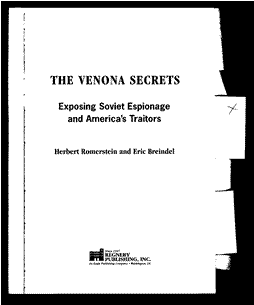
    Oh, but, who cares what some old dead guy said in a dusty old book years ago? Well, try: 'The Venona Secrets: Exposing Soviet Espionage and America's Traitors,' for some light reading. This book is fully foot noted with sources and copies of documents. It should shake denial right out of your vocabulary.

    When you finished with those, read The CommunistInternational, of the three tomes, read this one first: 1919-1943 Documents.

    The author acknowledges her work would not have been possible without the "generosity" of the Rockefeller Foundation. These three volumes (at a cost of about $135.00 each when you can find one), go step by step how the countries on the globe will first be colonized, who will get destroyed in war and the relentless march towards world communism. You can see history laid out right before your eyes. The quest for global domination under communism isn't dead, folks.

    Kevin Hornbuckle was elected to the city council in Eugene, Oregon, in 1992, as a registered Democrat and then came out of the closet to proudly announce in an interview: "I'd simply point out that Communists in the United States are fighting for health care, housing and jobs as a human right. I'm proud to be a communist."

    How many more Communists are in the closet undermining and subverting our Constitution and sovereignty? Not only are they being elected to public office under false pretenses, these America haters are teaching in high end colleges and universities throughout the country. Your son or daughter is being taught the toxic and destructive doctrine called communitarianism (communist morality); see here.

    Comrade Obama's "czars"

    Global warming hoax czar-ette is Carol Browning, the former Clinton-era director of the unconstitutional Environmental Protection Agency (1993-2000). Browner is a "liberal progressive." She is a socialist right down to her red knickers.


    September 04, 2009

    (CNSNews.com) – "Cass Sunstein, President Barack Obama’s nominee to head the Office of Information and Regulatory Affairs (OIRA), has advocated a policy under which the government would “presume” someone has consented to having his or her organs removed for transplantation into someone else when they die unless that person has explicitly indicated that his or her organs should not be taken. Under such a policy, hospitals would harvest organs from people who never gave permission for this to be done."

    The list goes on. Yesterday (Labor Day), the usurper announced his selection for Manufacturing Czar. I give credit to Glenn Beck, actually his staff, for their meticulous research of all Obama/Soetoro's anti-American czars. The entire list is here. Please note how many have 'unknown' next to salary. The American people are being raped in taxes to pay for all these comrades, yet we are not allowed to know what these dangerous individuals are being paid?

    The whole crew is part of Obama/Soetoro's agenda to restructure our constitutional republic into a modern day Soviet Union. Okay, scoff all you want at such a statement. I know otherwise because I have studied this for almost 20 years while boobs out there who huff and puff and say it ain't so have been glued to the great programmer (TV) watching nonsense. If you want to know how Americans have been seduced over time to accept what once was the unacceptable, read these when you have time:


    You can't fight your enemy if you can't identify who they are and their battle plan.

    Are these czars constitutional? That means does Obama/Soetoro have any legal authority to "appoint" these people?

    No, he does not. Remember when new world order minion, Papa Bush, appointed Bill Bennett his new "drug czar"? Where were conservatives then? Why weren't they demanding Bennett be sent on his way because Bush had no legal authority to appoint this czar? Now, "conservative" Republicans in Congress are making lots of noise about Obama's czars. Same old hypocrites.

    Many are jumping up and down chanting, "This is socialism." No, it's communism. There is a difference between all these forms of government:

    Marxism: The political and economic ideas of Karl Marx and Friedrich Engels as developed into a system of thought that gives class struggle a primary role in leading society from bourgeois democracy under capitalism to a socialist society and thence to Communism.

    Communism: A theory or system of government in communal ownership as in goods and property are distributed for a11, except those at the top who control the masses.

    Fascism: A philosophy or system of government that is marked by stringent social and economic control, a strong centralized government usually headed by a dictator, and often a policy of belligerent nationalism; oppressive or dictatorial control.

    Obama/Soetoro is often referred to as a "cultural Marxist." He is that and more. The usurper spent 20 years attending Rev. Wright's church and getting a good dose of Marxism dressed up as "Black Liberation Theology." Oh, that's right. Obama/Soetoro didn't hear any of it, just like Billy Clinton didn't inhale or "have sex with that woman." For a superb analysis on that issue, read: The Marxist Roots of Black Liberation Theology

    Last February, Senator Robert Byrd, to his credit, sent the usurper a letter admonishing him for all these czars. Why? Byrd patiently explained to the hot shot lawyer in the White HOuse that they violated "both the constitutional system of checks and balances and the constitutional separation of powers, and is a clear attempt to evade congressional oversight." I can find no reference (on the Internet) that Byrd raised an objection to Papa's Bush's unconstitutional appointment of Bill Bennett. However, since Obama has "appointed" more czars than any past ruler of Russia, I guess Byrd feels the senate is being pushed aside.

    Obama’s Unconstitutional “Czars” - August 29, 2009: "As I read it, the Constitution is very specific about whom the President may appoint and he can do so only within parameters “established by law” and this applies specifically to the “heads of departments.” I interpret this to mean Cabinet Secretaries, all of whom must be vetted and approved for their positions by the Senate.

    "The Republican National Committee's conservative caucus recently passed a resolution expressing their concern noting that “The U.S. Constitution explicitly states government officers with significant authority (called ‘principal officers’) must be nominated by the President and are subject to a vote of the U.S. Senate.”

    Obama’s appointments are clearly “principal officers” though it will be argued that they are only advisors to the office of the President. Clearly, Obama’s appointments are not heads of departments, but they appear to have been granted an unknown degree of influence and control as regards their responsibilities. They function “in the dark.”

    What can be done?

    This is the crux of the matter. Individuals and businesses must fight back. How? If any decision, recommendation, policy or otherwise is issued that affects you or your business, a lawsuit must be filed. Not pro se (meaning by the individual), but by experienced constitutional attorneys who know the U.S. Constitution and the Leviathan maze called federal courts. Who says we have to take this from Obama's "czars"? I say we don't. No one wants to do more court battles, but this issue of czars and conflict with the supreme law of the land must be resolved as quickly as possible. Both parties have sat back over the decades and allowed this kind of nonsense to go on and under Obama/Soetoro, it has reached the breaking point.

    For one thing, as a usurper, Obama/Soetoro has no legal authority to do anything. He sure as heck has no legal authority to appoint these czars with their toxic ideology to run rough shod over we the people. This is our country, not theirs.

    There are outstanding constitutional law firms in this country with the best legal minds who can take this to court and win. The question is: Will we fight or simply whimper along with a thousand excuses?

    I highly recommend these research items and commentary:


    © 2009 - NewsWithViews.com - All Rights Reserved

    Devvy Kidd authored the booklets, Why A Bankrupt America and Blind Loyalty; 2 million copies sold. Devvy appears on radio shows all over the country as well as her own; ran for Congress and is a highly sought after public speaker.

    She left the Republican Party in 1996 and has been an independent voter ever since. Devvy isn't left, right or in the middle; she is a constitutionalist who believes in the supreme law of the land, not some political party. Her web site contains a tremendous amount of information, solutions and a vast Reading Room.

    Devvy's website: www.devvy.com

    It isn't possible to respond to 20,000 emails a month. Before you send Devvy e-mail, please take the time to check the FAQ section on her web site; it has been updated and filled with answers to frequently asked questions and links to reliable research sources