Natural News Store

Showing posts with label Federal Reserve Bank. Show all posts

Monday, July 11, 2011

The Bankers Manifesto of 1892

"This [Federal Reserve] Act establishes the most gigantic trust on Earth. When the President signs this bill, the invisible government by the Monetary Power will be legalized, the people may not know it immediately but the day of reckoning is only a few years removed.... The worst legislative crime of the ages is perpetrated by this banking bill."... "The financial system [...] has been turned over to the Federal Reserve Board. That board administers the finance system by authority of [...] a purely profiteering group. The system is private, conducted for the sole purpose of obtaining the greatest possible profits from the use of other people's money." ~ Charles August Lindbergh Sr.

The Bankers Manifesto of 1892

Revealed by US Congressman Charles A. Lindbergh, SR from Minnesota before the US Congress sometime during his term of office between the years of 1907 and 1917 to warn the citizens. He also opposed both American entry into World War I, and the 1913 Federal Reserve Act.

"We (the bankers) must proceed with caution and guard every move made, for the lower order of people are already showing signs of restless commotion. Prudence will therefore show a policy of apparently yielding to the popular will until our plans are so far consummated that we can declare our designs without fear of any organized resistance.

The Farmers Alliance and Knights of Labor organizations in the United States should be carefully watched by our trusted men, and we must take immediate steps to control these organizations in our interest or disrupt them.

At the coming Omaha Convention to be held July 4th (1892), our men must attend and direct its movement, or else there will be set on foot such antagonism to our designs as may require force to overcome. This at the present time would be premature. We are not yet ready for such a crisis. Capital must protect itself in every possible manner through combination (conspiracy) and legislation.

The courts must be called to our aid, debts must be collected, bonds and mortgages foreclosed as rapidly as possible.

When through the process of the law, the common people have lost their homes, they will be more tractable and easily governed through the influence of the strong arm of the government applied to a central power of imperial wealth under the control of the leading financiers. People without homes will not quarrel with their leaders.

History repeats itself in regular cycles. This truth is well known among our principal men who are engaged in forming an imperialism of the world. While they are doing this, the people must be kept in a state of political antagonism.

The question of tariff reform must be urged through the organization known as the Democratic Party, and the question of protection with the reciprocity must be forced to view through the Republican Party.

By thus dividing voters, we can get them to expand their energies in fighting over questions of no importance to us, except as teachers to the common herd. Thus, by discrete action, we can secure all that has been so generously planned and successfully accomplished."

Source

Carnegie, the Rockefellers, the late Jay Gould, E.H. Harriman and J.P.Morgan, and most of those who have individually amassed wealth by the hundreds of millions, began with little or nothing in the way of capital, except their ability, and the system which permitted their enormous accumulations. As I have already said, it is the system that deprives the plain people of the profits resulting from their work, and gives it to the class of men mentioned. It ought to be of comparatively little satisfaction to this generation to let the system remain unaltered and calmly sit back and allow these enormous fortunes to be accumulated. It is undoubtedly true that the present possessors, if the laws of devise and inheritance were abolished, would dispose of most of it as they wished while still living, but there would be a new set on hand to rob our children.

The only excuse for government is the facility it affords its citizens for securing advantages that operate for the common welfare, which could not be secured with the same degree of equability through independent individual action.

Instead of that, our government, which is of our own creation, has insured to the banks and other trusts a system which renders it easy for them to oppress the masses. It enables the few to live as non-producers and exorbitant spenders, while almost the entire burden falls on the rest of us. Such a condition is impossible of long tolerance by the proud, honest and intelligent citizens of our country. We must seek for a remedy.

Banking and Currency and The Money Trust, Charles A. Lindbergh, 1913, PP.158-160

Sunday, July 10, 2011

PLEASE READ AND REPOST! Monetary Collapse, Agenda 21 and Understanding Freedom

What if the Federal Reserve dollar falls – hard? How is the globalist blueprint known as Sustainable Development Agenda 21 designed to make humans into livestock? Why liberty must be understood by this generation of Americans lest it be lost for a very long time.

More Americans, an accelerating percentage of ordinary citizens, have come to understand the nature of “fiat” monetary system – that is money created out of thin air. The contemporary fiat system came to the United States in 1913 with the congressional creation of the privately owned United States Federal Reserve. The Federal Reserve legislation violated Article 1 Section 8 of the Constitution by the issuance of legal tender and brought once again the influence/control of the globalist banking cartel to the U.S.

Today’s global monetary system was originally authorized by the British Parliament. Its purpose was to form the central bank of England as the Bank of England, which is the equivalent to our Federal Reserve, to control a nation’s money.

“Issuing money” means controlling fiat (phony) money creation through the operation of a printing press or computer entry. This results in the regular increase in the money supply which ultimately expresses itself as price inflation.

Newly issued money is infused into the money supply via the creation of debt. Much of this debt is held by the federal government. More money equals more debt. ‘The harder I work’, says the average American, ‘the deeper in debt the nation becomes.’

Growing debt cedes the ultimate exercise of control to the creditor, particularly as the system breaks down under its own largesse. A “new” system is being designed by the same forces who designed today’s fiat system and who now have America close to the brink of dollar destruction. It is the replacement system that we must be wary of if we are to exercise a wise defense and restoration of freedom.

In the meantime keep your faith in the dollar’s viability. Don’t let the blame for its destruction be placed upon the people. The creators of funny (fiat) money have the advantage and they control its destruction; they are wholly responsible.

The power in having charge of the printing press provides control of the direction of government. A thorough analysis of that control would be an illuminating dynamic.

After all, we can begin to think of how Congress has taken physical control over a large percentage of American land in violation of strict constitutional limitations on federal government land ownership. No doubt this centralized land and resource control works to the benefit of the globalist financiers.

Another example: American government, at all levels directs funds and partners with Smart Growth advocates and participants in an effort to remake society while herding people and controlling human action. Smart Growth operates pursuant to the ultimate and documented Agenda 21 objective – to massively reduce human population.

And another: Increasingly Government institutes policies and programs that monitor and control your every action, e.g., TSA, cameras everywhere, Smart Meters, bio-metric drivers’ licenses, and more.

Understand what the global elite’s control of money is doing to the world’s inhabitants.

Thomas Jefferson warned: “I believe that banking institutions are more dangerous to our liberties than standing armies. If the American people ever allow private banks to control the issue of their currency, first by inflation, then by deflation, the banks and corporations that will grow up around [the banks] will deprive the people of all property until their children wake-up homeless on the continent their fathers conquered. The issuing power should be taken from the banks and restored to the people, to whom it properly belongs.”

Congress has passed legislation that built debt of trillions owed to the Federal Reserve. America’s creditors are the descendants and current representatives of the creators of the globally controlled monetary system in which the Federal Reserve simply participates.

In order to subject America to Globalist political and economic control, Congress has made possible the construction of a financial house of cards – our currency! Fiat systems either implode through the forces of economics or are imploded by those in control.

One can anticipate that the core globalists’ power is planned to increase as they scheme to take charge of the selection of the replacement monetary system. While springing this new monetary system, globalists will have created supporting systems of justice and government for this new monetary model. Such is the New World Order.

This ‘new’ order must be understood to be a process. The question of our time is: How far along is this process?

Advancing Globalism – Agenda 21

The new order grows out of ownership and control of the monetary system. This power already controls: compliant governments around the world, multinational corporations, and education and academia designed to create a new man – one unconnected to the principles of the past. An existent infrastructure for world government has been established that includes the World Bank, the World Trade Organization, the Bank of International Settlements and the United Nations. The United Nations in turn accredits thousands of so-called Non Governmental Organizations (NGOs) for the purpose of implementing the United Nations’ Agenda 21. Agenda 21 is the “comprehensive” blueprint for the construction of a global-to-local network of localized outposts of the global order.

Agenda 21 is known in counties across America as “Sustainable Development.” Sustainability policies are now pursued in every county in the United States. Agenda 21 is the globalist program designed to achieve the step-by-step abolition of private property, education for global citizenship and control over human action. This control includes the written objective that human population be reduced by 85%.

As noted above, every county in America has adopted its own Sustainability program. It is often couched in the advancement of the so called Three Es: Equity, meaning the use of sociology and the remaking of the law to meet government’s social objectives and establish a collectivist society; Economics, meaning the international redistribution of America’s wealth and meaning the conversion of our economy from a free enterprise system based on private property to a system of “public private partnership” (otherwise known as economic fascism or corporatism); and Environment, meaning nature before man.

Upon examination one can begin to see how Globalism is advanced through the local implementation of Agenda 21. The key elements of the land use component of Agenda 21 are the Wildlands Network and Smart Growth. Between these two programs, people will be herded into metropolitan environs while made reliant on public transportation and subjected to increasing monitoring. The Wildlands – 50% of America’s land mass plus buffer zones fronting the Wildlands – will be off-limits to ordinary people and to resource extraction. This program is advanced from a thousand points of darkness lead by the environmental movement in action.

The battlefield for Sustainable Development has become local. Agenda 21 is implemented through your city council, County Boards of Commissioners, local water boards, fire boards, school boards and more. Elected officials have accepted the bogus Sustainable “consensus” advocated by NGOs and other followers of Sustainability policy.

A prime player in bringing globalist policy to locales like yours is ICLEI, the International Council for Local Environmental Initiatives. Over 600 cities or county governments have treasonous contracts with this international NGO. A handful of cities, recently and in response to an informed citizenry, have cancelled their contracts. In these communities, local policy must now be cleansed of globalist influence. The process has begun. The battle is on! Now is the time to cleanse your town of Agenda 21 policy! KICK ICLEI OUT!

Other significant contributors to Agenda 21 policy at the local level are the federally established Metropolitan Planning Organizations (MPOs) and the Councils of Governments (COGs). These soviet style organizations work to impose Sustainability policies in their member jurisdictions. Cities, counties, school districts and other local political subdivisions need to withdraw from these extensions of the federal commitment to implement Agenda 21. It becomes clear that these organization types were created in order to further an evolving globalist agenda. Regionalism is the pathway to New Order governance!

The commitment to Agenda 21 is fully imbedded in American government, business and educational systems.

Restoring America; Every Person Matters

The American ideal was predicated on the idea of the political recognition of the unalienable rights of the individual. That is the notion that human beings are vested by their creator with an unalienable right: to life, to liberty, to the use and enjoyment of private property and to other undesignated rights that are natural to man. This experiment in governance necessarily limited the scope of government power so as to not infringe on these natural rights while charging the citizens as being responsible for their own lives. Accordingly, philosophers, historians, and ordinary people have claimed that America’s Declaration of Independence is mankind’s greatest achievement. Now that achievement is being buried under Agenda 21’s onslaught.

Understanding what we are up against is critical if we are to win the war to defend and restore liberty. That’s why seeing how the global-to-local action people operate – including the legions pursuing globalism within NGOs, academia, multinationals and more – is key if we are to reverse freedom’s fall. Today we need to revive our commitment to human liberty in order to survive the globalist onslaught.

While it is important to know what it is that we are fighting against, it is also necessary to know what we fight for. The fact is that liberty is being abandoned through the plunder of private property and the crush of privacy engineered through a system of fiat money created and manipulated by those with a maniacal pursuit to control the human species.

So what is the liberty we cherish? Liberty exists when there is a political recognition that everyman owns his life, when justice is applied equally, and when the economy proceeds naturally on the basis of free enterprise. Liberty acknowledges that man is nature’s steward and that stewardship is best advanced under a system of personal responsibility pursued in the context of advancing one’s own life. A private property forest owner has as a primary interest the long term protection of the land’s resource. This is why genuine private property rewards both its owner with continuing income and the market he serves with ample product.

Why is America the only place where human beings have lived free? The answer is simple. America is the only place where the government has recognized that every person is vested with certain unalienable rights. America falls as that recognition fades.

How does America revive? We must establish an honest monetary system and we must cleanse our municipal, state and federal laws of globalist policy as articulated in the Action plan of Agenda 21. As a consequence, we will: withdraw from internationalist organizations, restructure debt, massively shrink the scope of governmental operations, and reassume the American form of limited government where individual liberty can thrive.

Hope, predicated on a commitment to restore the principles of liberty, is rising. The course of the future is up to you.

Every person can make a difference.

© 2011 Michael Shaw - All Rights Reserved

Michael Shaw is a leading critic of Sustainable Development, also known as the U.N.'s "Agenda 21," which is he Action Plan implementing the Globalist one world vision. This year Michael has been and will be speaking around the country, delivering his current speech: The Ultimate War: Globalism vs. America. In this expos -- he illustrates the local infiltration of globalist policy in the community in which he is speaking.

Shaw leads Freedom Advocates.org which is dedicated to providing news and information on what America stands for and how Agenda 21 is designed to transform America and the human experience.

Web Sites: FreedomAdvocates.org & Liberty Garden

E-Mail: Shaw@FreedomAdvocates.org

PLEASE READ AND REPOST! Monetary Collapse, Agenda 21 and Understanding Freedom

Sunday, September 13, 2009

Green Shoots and White Lies


Hark! Hear the buzz?
It’s the sap of the economy stirring.
Animal spirits are back on the prowl.
Just this week, a Schwab analyst argued that the recovery would be much stronger than expected.
Down in the federal maternity ward you can hear the squall of new life as Team Obama slaps cold flesh and breathes life into clammy infant lips.
Recovery is abornin’

How Green Are Our Shoots!
Thus say both Chairman Ben Bernanke and Treasury Secretary Tim Geithner. And the public believes them. How come?
It all began in March. In the first televised interview by any sitting Fed chairman in 20 years,1 Bernanke used the term, “green shoots” for the first time. He pointed out that the Dow Jones index had recovered from 12 year lows in 2008 and the banking system had stabilized. No more big banks would fail, he predicted.2
Two months later, His Timness echoed Big Ben. Geithner cited reduced spreads on corporate and muni bonds, the reduction in costs in credit protection at the big banks, and smaller risk premiums in the interbank market. He too said the economy was recovering.3
In June, World Bank President Robert Zoellick joined the ’shooters.’
Zoellick is a former US trade representative notorious for forcing US government subsidies and trade policies inimical to small farmers onto emerging markets. Zoellick noted “signs of global recovery,” but cautioned that they might be killed off if protectionism were adopted.4
Translation: foreigners had better not object to US government-managed trade policies…or the global recovery will fold.
Put out… or look out.
Zoellick added his own revealing metaphor to the shooter lexicon: “Right now there is a low-grade fever; it isn’t full influenza, but we need to keep a close watch…” [my emphasis]
Oddly, Zoellick’s own employees at the World Bank contradicted their boss’s assessment in a report only a couple of weeks later. (See “World Bank Global Economic Outlook” below.)
By then billionaire hedge-fund manager George Soros was also seeing green. And in July, chief wonk of the Obama economic team Lawrence Summers detected greenery in remarks to the Peterson Insitute for International Economics.

Green shoots were now being sighted by everyone
:
    In July the International Monetary Fund published its World economic outlook update. The Fund revised expected global growth in 2010 upward to 2.5%. The main source of the improvement, it claimed, was a brightening outlook for Asia.

    Simon Johnson, IMF economist–turned-Peterson-Institute-spokesman-turned green-shooting-star even went on PBS to announce, “we are turning some sort of corner.” (August 20, 2009)
    Surveys of economists and business leaders in the summer showed that, in contrast to only a few months earlier, slightly more than half thought that the economy had bottomed.
Question: How can a depression heralded as equal to or worse than the Great Depression, a depression described as a ‘reckoning’ for over a quarter of a century of economic misdeeds, correct itself in less than a year?
Answer: It can’t.
Yet, by mid-year, that’s exactly what pundits were telling the public. And that’s exactly what the public was beginning to believe. Not surprisingly, by mid-year, stock markets the world over had rebounded sharply.
White Hats and White Lies
But the economy hadn’t really turned any corners. What was unfolding was a giant sleight-of-hand. The “good guys” of the liberal corporate-state were pulling a fast one, doing two contradictory things at the same time.
On one hand, Team Obama had to admit the enormity of the crisis, in order to justify the size of its own rescue efforts. Thus Tim Geithner in his statement to the banking committee in May took care to note the following:
1. The economy had lost 2.1 million jobs from December to February ‘09, the largest three-month decline since 1945. (the second-largest three-month decline in 1975 was only half as big).
2. GDP fell at an average annual rate of 5.9 percent in Quarter 4 ‘08 and Quarter 1 ‘09 — the fastest six-month rate of decline since 1958.
3. Even before policy changes, the Congressional Budget Office was projecting a budget deficit for 2009 well in excess of a trillion dollars because of the weak economy.
4. The US faced economic problems of such a “unique character” that Congress had had to adopt the largest fiscal stimulus package in the nation’s history, at 5% of GDP.
On the other hand, Team O also had to pretend that the rescue had improved things dramatically or people would ask what the point of it was.
The Obamites managed to pull this off with a slew of white lies.
Some of the biggest ones:
Fudge OneGoldman Sachs had a great quarter, making a profit of $3.5 billion and the government made $1.4 billion on its investment in Goldman Sachs. The government also got a 15% return on its investment in the eight biggest banks.
Truth: Goldman had a great quarter only because it moved its reporting calendar to cut out December 2008, when it had a loss. And the goverment only made a profit on the TARP money it gave to Goldman because
    It funnelled more money via the bail-out of insurance giant AIG to AIGs counterparties, including Goldman (which took in $13 billion of the AIG money).
    Warren Buffett made a pre-TARP financial investment in Goldman.
    Goldman got the benefit of exceptionally low interest rates from the government at the expense of savers and to the benefit of borrowers.
    Goldman was issued FDIC-guaranteed bonds.
Without that extra welfare thrown at it, Goldman would actually be broke, not showing a profit. Ditto for the other banks.
Fudge TwoThe labor market is getting better because jobs are growing. The unemployment rate fell from 9.5% in June to 9.4% in July.
Truth: That number only shows a slowing in the growth of unemployment. And even that small improvement has been offset by other aspects of the labor market that are worsening quite sharply:
    The duration of uemployment is increasing.
    Temporary jobs are declining.
    The percentage of the eligible population receiving unemployment insurance has increased (0.1 percentage point to 4.7%. by September).
    The four-week moving average of initial claims has moved to its highest level in a month5
Even when jobs have been added, they’ve been created by government spending and they’ve been in areas like education, health, and government. In the purely private economy, in manufacturing, construction and retail, job losses have been huge.”6
Note: Recent improvement in the ISM (Institute of Supply Management) Index that signals expansion of production (and thus hiring) also needs to be discounted against the huge price inflation an increasingly pressured dollar will entail. That’s beside the effects of a hike in the Federal Funds rate that’s bound to follow a dollar crashing scenario.
Note also: The ISM is a leading indicator of executive expectations for future productions, orders, inventories hiring, and deliveries.
Fudge ThreeIncreases in real personal income in April and May will increase consumer spending.
Truth: The increases were caused by tax-rebates and unemployment benefits kicking in, and most of it was saved, not spent (80 cents on the dollars). There was a temporary lift in consumer spending, but it petered out quickly. And as unemployment rises, benefits decline, and credit tightens in the future, consumption will decline even further
Fudge FourThe bank stress tests came out better than expected.
The bank stress tests led Ben Bernanke to conclude that nearly all of the banks had enough capital to absorb higher losses should the economy worsen, and that the Treasury stood ready to provide more.7
Truth: The bank stress tests used an unemployment figure of 10.3% (the most adverse case). But unemployment is likely to be 11% and above by next year. If you take into account discouraged and partially employed workers, some economists suggest the figure is more likely to be 16%.
Another point. The stress tests overlooked all the other ways in which the government was paying for the banks, through FDIC guarantees and cheaper loans, for instance.
Fudge FiveThe housing market is improving.
In July, the Pending Home Sales Index was up 3.2%.
Another improvement was in the value of U.S. homes. In the second quarter that number fell year-on-year (the 10th consecutive quarterly decline), but it fell by a smaller amount than in the previous quarter, for the first time since 2007.
Truth: The improvement in home sales has been mostly in the lower end of the market and it largely reflects foreclosure sales and government credit, not real improvement in the market.
The slow-down in price decline has been offset by negatives in other areas:
    23% of all homeowners owe more on their mortgages than their houses are worth.
    22% of all home sales nationwide in June were foreclosure resales.
    29.2 percent of all homes sold in June were sold for less than the owners originally paid.8
Loan problems aren’t confined to subprime. Prime mortgages are going underwater too.
Meanwhile, the market also has to deal with the decline in commercial real estate, which is undergoing one of the greatest contractions in retail in decades. Rents, even in the best urban shopping districts, have been declining.9
Beyond commercial real estate, there are also all the other plagues about to visit us, when personal loans, auto loans, and student loans tighten over the coming years.
Bottom line? There is no real basis for sustained optimism about the economy yet. 
Simon Johnson’s relatively upbeat assessment reflects only temporary inputs:
    the government’s reflation effort (that created cheaper credit)
    business write-downs (that created better balance-sheets)
    the business cycle (that leads to restocking and inventories rising)
Johnson cites low inflation as another positive factor. However, with all the money pumped into the economy (including the latest cash-for-clunkers scheme), that’s also unlikely to be anything more than temporary.
This harsh reality is reflected in the World Bank Global Outlook Report of June 22, 2009. It notes the following for 2009:
    Global growth is set to fall by 2.9%
    World trade is likely to shrink by nearly 10%
    Industrial production in rich countries will drop by 15% from August 2008
    Developed economies will contract by 4.5% in 2009 and grow only in 2010 and 2011
    The US economy will decline by 3%
    Private capital flows to developing countries are likely to be halved, from $US 707 billion (2008) to $US363 billion (2009)
    Industrial production in developing countries, excluding China, is set to fall by 10%
    GDP growth in developing countries will fall from 5.9% (2008) to 1.2%.
A Verbal Pandemic Infects the Economy
Given this underlying reality, the media’s success in manipulating market sentiment has been nothing short of astounding.
And all it seems to have taken was the viral proliferation of a single meme. Call it a verbal pandemic.
Go back to March, when there was a second rescue of AIG and Citi in the offing, the Madoff investigation was expanding, and the US had a face-off with China.10 Fear was widespread and consumer and business confidence were at multidecade lows.
To take one indicator, Google searches for “economic depression” were four times what they were before the crisis broke in 2008.
Then Bernanke came out with the phrase, “green shoots.” After he introduced it, it showed up 3,123 times in news articles that month. Compare that to 436 in February (according to Nomura Holdings Inc. research).
Bulls and bears both used it. It was applied to the Israeli-Palestinian conflict and to the Iranian demonstrations.
In four months, ‘green shoots’ had grown seven-fold
Today, a Google search for the meme fetches 3.31 million hits.
As the phrase spread across the media, Bloomberg noted that business and consumer confidence spread with it. Sentiment changed. People stopped panicking and started talking about buying opportunities. It was that change in mood that let administration economists build their flimsy case for economic recovery.
Take a look at Summers’ list of improving indicators in his speech at the Peterson Institute on July 17. You’ll see the proof. At least five of the metrics Summers cites relate to sentiment. I’ve highlighted the relevant words.
    Most businesses are now expecting better times, not worse, as they’d expected 6 mths earlier.
    Consumer sentiment is improving.
    Options are showing a less than one percent chance of the Dow falling below 5000 in 2009 (they were once showing a better than 15% chance).
    Private forecasters are expecting positive growth at the end of 2009.
    Google searches for economic depression are back to normal. (Yes, that’s on Summers’ list).
Let me repeat this.
It took two simple syllables, neither beyond the reading ability of a pre-schooler, for people to discount the hard evidence of the numbers and the harder evidence on the streets in favor of a sales pitch by the government.
We might even go a bit further. The stimulus by itself can have done no more than buy time for the banks and take the pressure of the interbank market. It’s taken sustained propaganda for banks and businesses to regain enough confidence to operate.
And they’ve regained confidence not in the economy, but in thegovernment.
In brief, a story-line two words long shows up rational man of for a fiction and a fraud. Economic man, the maximiser of his self-interest, turns out not to exist.
Of course, outside economic text books, he had never existed. Man, as we find him in the world, adds up numbers as an afterthought to his feelings. When he feels good, he massages his numbers upward. When he feels bad, the numbers are downcast with him.
Economists who have caught on to this know that what they practice is no science of enlightenment. It is a black art. The knowledge keeps them humble.They stick to describing things the way things actually work. They look just ahead of their noses and count themselves lucky if they can balance their check books at the end of the day.
But government economists labor under the delusion of omnipotence. To a man, they believe they can make bull frogs sing in tune and bats bathe in the sunshine. It isn’t enough that their theories blew up the market. For that alone, lesser men would have cut open their veins or thrown themselves under a passing tram.
Now the delusion is they can fix it. And that is where the meme of ‘green shoots’ figures. It’s task was not so much to boost confidence in the markets as it was to boost confidence in the ability of government experts to fix markets.
For that, visible success.. or even marginal competence.. is no longer needed. The old rain-men had to make rain or they were fed to the lions. The rain-men of today can produce drought… or famine, or even plague and theybecome lions.
The more they fail, the more they are believed. When they have been completely refuted, they become Nobel laureates. They may not know what ails the market, but they know for certain it takes a village of economists to fix it.
Or, as economist Robert Samuelson put it in a sharp criticism of Summers’ speech at the Peterson Institute: “If the president and his allies claim often enough that their policies have succeeded, most Americans may believe them.”11
  • CBS, 60 Minutes []
  • AFP, March 15, 2009. []
  • Tim Geithner, Statement before the Senate Banking Committee, May 20, 2009. []
  • Reuters, June 8, 2009. []
  • Thomson Reuters, September 3, 2009. []
  • Brown manure not green shoots,” Nouriel Roubini, Forbes, July 9, 2009. []
  • AFP, “Hope is alive for ‘green shoots’ as stress tests trigger optimism,” May 11, 2009. []
  • Portfolio.com August 11, 2009. []
  • Colliers International Spring 2009 Retail Report, May 14 2009. []
  • Nightmare on Wall Street,” Lew Rockwell, April 1, 2009. []
  • Summer’s Spin: We Did It,” Newsweek, July 17, 2009. []
  • Lila Rajiva is a freelance journalist and the author of The Language of Empire: Abu Ghraib and the US Media (Monthly Review Press, 2005) and Mobs, Messiahs and Markets (with Bill Bonner-Wiley, September 2007). She has also contributed chapters to One of the Guys (Ed., Tara McKelvey and Barbara Ehrenreich, Seal Press, 2007), an anthology of writing on women as torturers, and to The Third World: Opposing Viewpoints (Ed., David Haugen, Greenhaven, 2006). She can be reached at lrajiva@hotmail.comRead other articles by Lila, or visit Lila's website.

    http://dissidentvoice.org/2009/09/green-shoots-and-white-lies/


    Friday, August 14, 2009

    Nonsensical Economy & Champion Greenbacks


    moneytoburn.jpg

    I never gave much thought to money in my life, and usually vilified it in my mind when I did.  To this day, we live entirely on sporadic donations and a very few article sales, have no savings and prefer barter.  That said, money has never seemed plentiful enough to waste.  Yet looking at how our economy functions and what incentives our government offers, you’d think money was to burn.

    Frankly, there’s something wrong with an economic system that depends on a constant increase in production, spending and debt just to avoid complete collapse.  Here’s how it works, just is case you didn’t fully understand: The economy suffers even if we spend and produce the same, exactly the same amount as the year before.  It requires not only that we buy ever more stuff, needed or not, but it also needs us to go into debt, the economy’s health depending increasingly on our purchasing things we cannot yet afford.  It’s sounds like something out of a bad science fiction movie, the ponderous creature that must constantly grow or die, needing to kill and eat ever more in order to remain on its feet.  All the frightened townsfolk need to do is figure out a way to slow it down and it will get sick and begin to die… but in the case of the ever expanding economy, if it sickens, we all suffer.  This is frankly nonsensical, and not a very promising model for doing business in a world that is of measurably limited size, created and then gifted to us with a finite amount of water for drinking, a specific number of acres suitable for farming, a still undetermined amount of minerals for industry, and at best only just so many salmon for sushi not matter how you shake your rod.

    President George Bush said that spending was patriotic, and his mantra was to “buy, buy, buy.”  Current President Obama is mortgaging future generations by his monstrous swelling of the national debt, spending a mint in the emergency room trying to save the life a sick patient that had never done anything to contribute to its own long term health.  Such approaches stand in stark contrast to the sentiments and strategies of our national past, with frugality and savings being an aspect of the American spirit since the founding of the country and the sensible proclamations of cofounder Benjamin Franklin.  President Theodore Roosevelt came from a wealthy family and was militarily an unapologetic expansionist, but he was also a conservationist who wanted to see wildlife, coal and oil reserves conserved, and a conservative who believed in Americans saving their hard earned money so we would be well prepared in case of future hardships.  Even later President Franklin Roosevelt, who’s “New Deal” initiated the first Big-Brother management of social services in an attempt to crawl out of the economic depression of the 1930’s, still preached the importance of conserving and recycling precious materials like steel, and instead of being encouraged to dump their few dollars at the nearest strip mall, they were told that the most sensible and indeed American thing they could do was to grow a “Victory” garden and learn to generally make rich lives with less.

    If there are any advantages to our system the way it works, it’s that it can fuel innovation and contribute to diversification.  And it’s great the way buying gives us a degree of individual and collective power.  We wouldn’t have to sign up for organized boycotts to start working in unison to influence the world we are in.  You don’t like a certain political leader?  Then refuse to give your business to any businesses associated with conglomerates that fund them.  Might take a little education on our parts, mercy sakes, but then we could start making every expenditure an informed decision.  Tired of work being contracted overseas?  Simple, pay a little more and buy American made.  Better yet, buy locally whenever possible, and be part of the solution for your own local economy.  If we want products that are made well and last long, instead of engineered to need regular replacement, then we need to research and buy the best made items we can afford.  Want to see less produced, then buy more used items, they’re often more cool anyway.  Can’t bear to see forests clearcut for pulp?  Pay for recycled or tree-free agri-waste paper instead.  We need to know what we truly need and most want, and then search out the best as well as the best priced, instead of going for the cheapest possible at WallyWorld, or making impulse purchases of crap that we’ll soon pitch in the closet or garage and never look at again.

    I believe I’d really have enjoyed being alive at an earlier date when both words and money were spent carefully, when meaningful conversation was of more importance than accumulation, when free time for having fun was seen as more valuable than owning more toys, when a good friend was considered worth more than a thousand investors, love more precious than gold and one’s word more bankable than a lawyer-penned contract.  That said, if cash is to be “king” like the classified ads often claim, then we might ought to consider making every purchase a personal decree.

    moneyasking.jpg

    Whether we make conscious spending decisions or not, we verily decide the culture we are a part of, not only who will lead it but what it will look like.  We could be equipped by vehicles that run for years without repair, long lasting tools powered by wind generators or who knows what, stores stocked with hard goods from somewhere besides Chinese sweat shops, our homes furnished with real wood and lovely if sometimes pre-owned material, if we only we insisted upon it and spent our unreasonably powerful dollars accordingly.  The fact that our political leaders range from puppets to paternalists, that 2/3 of what’s on the variety store shelves could be considered disposable, that multinational corporations are expanding while small town businesses close, that new cars only last a few years and come with tacky plastic body parts, is all determined by the spending choices we together and separately make.

    If I feel guilty and out of sorts going into that monolithic, many-tendriled discount store, saddened at the sight of the resigned blue-vested workers, shuddering under its flickering fluorescent lights and all-seeing cameras, it is not just because of the low wages paid its laborers, the jobs lost to the Orient when it orders its merchandise almost entirely from there, or the laid-off stateside workers now struggling to pay even the discount store prices for the food their family needs.  If I feel sickened, it is also because I know this particular monster – the same as our national economy – has to endlessly eat and expand its repulsive bulk if it is to survive… and I, in my haste to get a bargain on imported raspberries and an air cleaner for the Jeep, have helped to feed it.

    As I learn more, I increasingly intend that my scarce but powerful dollars speak loudly in support of individual liberties and my own personal values, that they impact the world I am a part of, if not always to an evident degree.  I no longer see the few computer encoded greenbacks in my wallet in the same entirely unpleasant light I used to.  They are my weapons of justice, agents of love and good taste.  They are my champions, few but now purposeful, dedicated and directed for an intended good.


    My response...

    Jesse, I agree with much of what you say, BUT…

    One must also take into consideration that U.S. dollars are not money, but debt instruments…fiat currency backed by nothing but debt, and as long as we consent to their use, we are part of the problem.

    In 1913, through careful calculation and political manipulation, the international central bankers got their Federal Reserve Act passed late in the evening on December 23rd after most of Congress was dismissed for Christmas vacation and their puppet, Woodrow Wilson then signed it into law, changing our nation forever.

    Later, Woodrow Wilson would go on to say…”I am a most unhappy man. I have unwittingly ruined my country. A great industrial nation is controlled by its system of credit. Our system of credit is concentrated. The growth of the nation, therefore, and all our activities are in the hands of a few men. We have come to be one of the worst ruled, one of the most completely controlled and dominated governments in the civilized world. No longer a government by free opinion, no longer a government by conviction and the vote of the majority, but a government by the opinion and duress of a small group of dominant men.” http://www.apfn.org/apfn/reserve.htm

    The only way to truly save our nation and our freedom is to get the Federal Reserve banks shut down, and remove the international central bankers behind them from having such power over our government and economy.

    There are alternative sources of real money that can be used instead of using debt backed Federal Reserve notes, and the more people who use them, the better we will all be. http://www.libertydollar.org/

    Other alternatives are bartering, as you mentioned, and setting up small community banks with your own money. 

    We as a people MUST think beyond the paradigms set for us by criminal bankers and their fractional reserve Ponzi scheme banking systems that are unsustainable and destructive.

    Saturday, August 8, 2009

    Fractional Reserve Banking in Pictures


    "The few who understand the system, will either be so interested in its profits, or so dependent on its favors, that there will be no opposition from that class. The great body of people, mentally incapable of comprehending the tremendous advantages, will bear its burden without complaint." - Lord Rothschild, European central banker

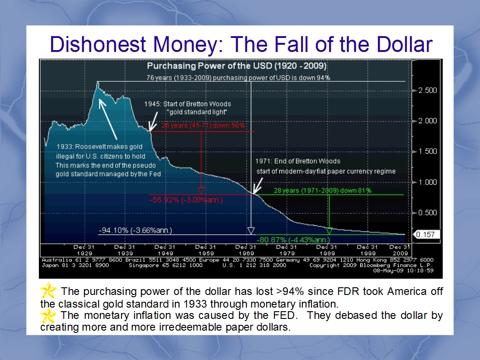
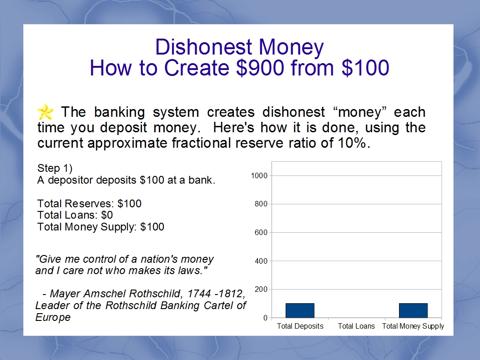
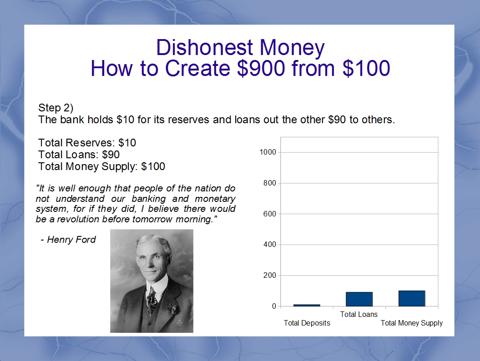
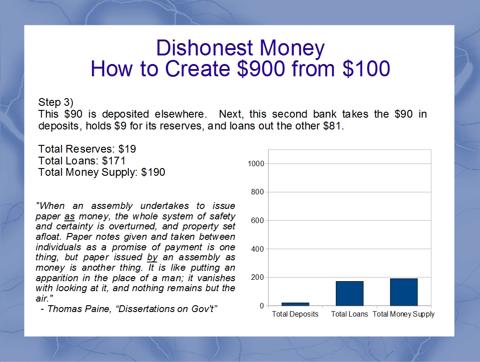
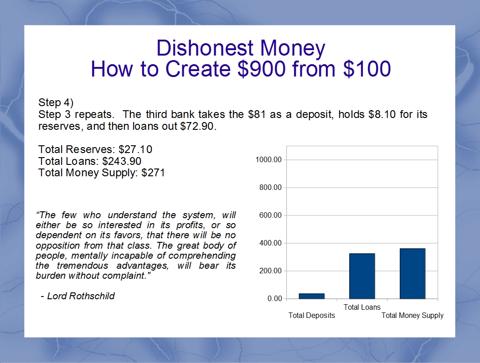
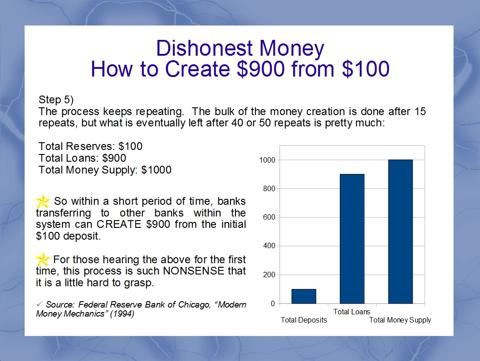
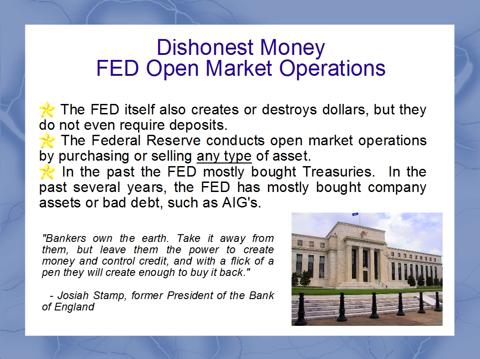
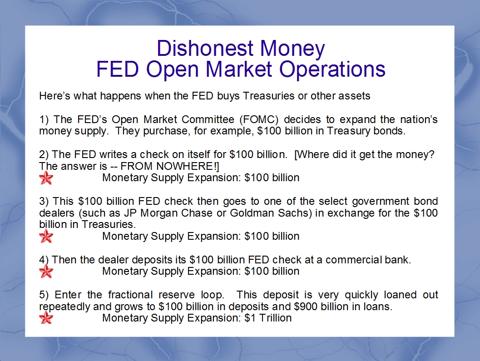
    The below slides are meant to explain fractional reserve banking as simply as possible using pictures. The presentation itself can be found here, and a written description and documentation in "The Money Matrix - How the FED Works (PART 6/15)".The below demonstration assumes a reserve requirement of 10%, which is the figure typically given by the banking industry and financial experts. However, in Part 2 I will demonstrate there there is effectively NO set reserve requirement though the banking system obviously carry some level of cash reserves. I alluded to this previously in "Off a Cliff with No Airbags: The FED Banking System Quivers in Fright".

    click to enlarge12345678Disclosure: Like everyone else in the USA, I am still long the dollar.