Strange as it may seem, a couple of weeks ago as I ruminated on Obama's broken promise to bring the troops home, his attempt to out-warmonger the Bush administration and his plummeting popularity, I thought to myself: "ya know, what that guy (or rather the disgruntled US public) needs is a good old fashioned 'Muslim terror attack'. Preferably one that includes a ranting 'terrorist' message about Afghanistan and 'slaughtering infidels'. That'll soon silence the rabble and get them behind Obama's Afghan surge!"
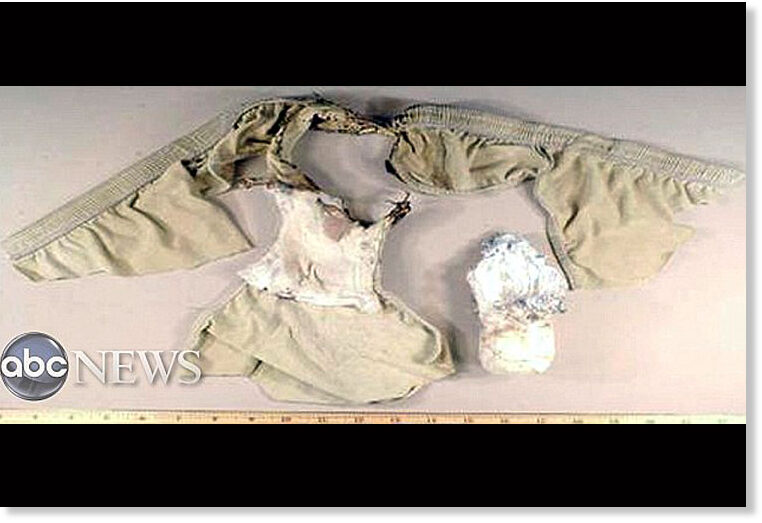
And so it was that, as I sipped my eggnog on Christmas day, I was shockingly unsurprised to read the headlines about an 'underwear bomb' (as shown above).
To adequately address the recent airline "terror attack" in Detroit and the airborne terror attacks in Yemen we must delve into the topsy turvey world of the 'war on terror', where black is white, up is down, and shady Middle Eastern-looking men and your knickers share equal rating on the US DHS threat-o-meter. In short, it's no easy task. So first of all, let me say a few words about airports and the old and new airport "security measures".
The nightmare that is modern commercial air travel started with 9/11. Before this date, air travel was reasonably civilized. There were no long queues (at least not after check in). We just threw our hand luggage on the security belt, walked through the scanner and we were done.
After 9/11 however, every commercial airplane became a potential flying bomb and passengers and their hand luggage had to undergo more extensive searches. In Dec 2001, the theatrics of the
clearly brain-washed Richard Reid, aka "the shoe bomber", added the common or garden shoe to the list of potential terrorist weapons. Now, the equally bizarre antics of the young Nigerian Mr Umar Farouk Abdulmutallab has thrown our underwear into the mix.
Both shoe and knicker bomber attempted to use PETN (a military explosive) on their respective flights. As a result, our shoes now go through scanners at airports and I can only presume that more invasive scanning of our lower torsos will also be mandated supposedly in an effort to prevent further knicker attacks. The problem, however, is this:
PETN, either in shoes or strapped to any part of the body, cannot be detected by airport scanners. A chemical test is needed. Unless authorities plan to drastically reconfigure the number and availability of international flights, there is no chance that chemical tests can be introduced for every passenger. Hence we reach our first tentative conclusion: that the billions of shoes that have been scanned at airports since 2001, and the billions of pairs of underwear that will henceforth become objects of official scrutiny, have and will have had nothing to do with airport security or preventing terrorism.
So what's it all about?
Follow me now, as I metaphorically wade through the vast piles of manure that constitute the raw material for the official story of the latest 'terror attack'.
The Christmas knicker bomber was not your usual disgruntled Arab or lowly Muslim acolyte. He was the son of Nigerian banking mogul and former Nigerian government minister Alhaji Umaru Mutallab, one of the richest men in Africa. We're talking one of the African colonial elite here, an African version of the British "
old boy's network" While in London, his son, the knicker bomber
lived in a ₤4 million apartment in Mansfield Street, in the city's West End.

'Terrorist' Mutallab (center) with his young and impressionable friends
He also enjoyed access to visas for several different countries, including the US.
It is not surprising therefore to learn that the knicker bomber apparently received special treatment at Amsterdam airport before he boarded his flight to Detroit.
Eyewitness Kurt Haskell reported that a sharply dressed Indian man escorted him to the gate and told the attendant that the knicker bomber had no passport but needed to get on the flight. The sharply dressed man was told that he would have to speak to the manager, which he apparently did and successfully got the young 'terrorist' on board.
Now this requires some serious string pulling, and all the hoopla in the press about whether or not the security system worked is just hubris, because if the knicker bomber appeared at the gate without a passport, it is unlikely that he went through the normal process up to that point, including check-in which requires passengers to show their passports. In all probability he was escorted as a VIP
to the gate by the sharply dressed man. So how do two suspicious looking terrorists, at least one of them without a passport, get to the gate in an airport and then onto the flight? The answer is they don't unless they have some diplomatic credentials or high-level contacts in the airport.
Guess who runs the security at Amsterdam Schipol airport?
ICTS of course! the same Israeli owned security company that somehow managed to let the shoe bomber on his Miami flight in 2001 and several of those mythical hijackers who allegedly flew out of Boston's Logan airport on 9/11. It is also useful to remember that the shoe bomber was cleared through ICTS and El Al security at Amsterdam airport on a flight to Tel Aviv in July 2001 for what was apparently an all-expenses paid week-long trip to the Israeli city. What precisely he did there remains a mystery.
All of which leads us to our second tentative conclusion:
The knicker bomber and his handler were not terrorists. Of course, it all depends on who you think the real terrorists are...
Moving on to the bomb itself; as mentioned it was PETN, or rather Pentaerythritol, which is a building block for PETN. To make PETN, Pentaerythritol must be mixed with concentrated nitric and sulfuric acids. It is assumed that these acids were in the syringe that the knicker bomber was attempting to inject, under the cover of a blanket, into his underpants. He then attempted to ignite the newly prepared PETN with some kind of a fuse. He was apparently unaware that PETN
requires a shock wave rather than heat or flame to detonate, and a shock wave is best provided by an initiator explosive. In short, the whole enterprise was doomed to failure from the beginning. Since the bomber and his smartly-dressed handler were able to get to the gate without passports, and are unlikely to have passed through security, we are left to ponder why the bomber didn't carry an explosive that required much less preparation, like a half a stick of dynamite for example.
Here's a short video of what a half stick of dynamite does to a file cabinet.
Tentative conclusion number three therefore is that the goal was not to actually 'kill infidels' but rather to reinforce the concept of 'Muslim terrorism'. In fact, it seems clear at this stage that the combining of terrorism and commercial air travel is a specific tactic by the real terror masters to maximise fear. After all, it is difficult to think of a place where the average citizen already feels more vulnerable than on a metal tube hurtling through the air at 35,000 feet. Add in a wild-eyed 'terrorist' and you have the optimal psychological conditions for fear-based programming.
In this particular case however, the knicker bomber was far from wild-eyed. According to the first passenger who attempted to subdue Mutallab on the plane, he offered no resistance and was docile. He was "staring into nothing" according to Dutch 'film maker' Jasper Schuringa. Schuringa also noted that Mutallab was actually on fire but showed no reaction whatsoever. This is suggestive of someone who is in some sort of trance. Indeed, Schuringa stated this explicitly in
this interview but immediately followed it with the words, "I don't want to talk about that."
How very strange.
Equally strange is Schuringa's
account of how he subdued Mutallab:
as the plane neared its destination of Detroit, Michigan, he heard a pop that sounded like a firecracker going off, and someone started yelling: "Fire! Fire!"
"Around 30 seconds later the smoke started to fill up on the left side beneath this person," he said.
"I basically reacted directly. I didn't think."
He jumped over the passenger next to him and lunged over Abdulmutallab's seat, "Because I was thinking he's trying to blow up the plane, and I was trying to search his body for any explosives."
"I pulled the object from him and tried to extinguish the fire with my hands and threw it away,"
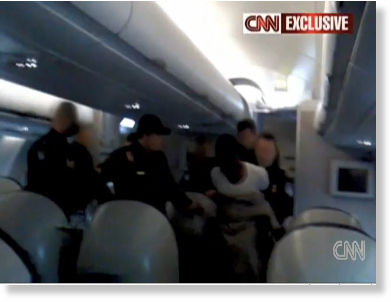
"Just to be sure I grabbed him with another attendant and we took him to first class and there we stripped him and contained him with handcuffs and we made sure he had no more weapons, no more bombs on him."
"The whole plane was screaming. The suspect, he didn't say a word."
Schuringa said other passengers applauded as he walked back to his seat.
The reactions of the other passengers seems normal. The reactions of Schuringa are reminiscent of someone who has been trained in anti-in-flight-terror tactics.

Jasper Schuringa's camera image of Mutallab as he is taken off the plane
According to reports Schuringa was on his way to visit an 'Israeli friend', Shai Ben-Ami who owns a restaurant in Miami. The flight landed at around noon on Christmas day, and by that afternoon Ben-Ami had become Schuringa's impromptu PR manager, aggressively negotiating fees for interviews and the couple of cell phone pictures that Schuringa had taken of Mutallab as he was being taken off the plane.
Eyewitnesses on the flight also reported that after Mutallab was taken off the plane the FBI arrested another Indian-looking man in Detroit airport. The FBI has since denied that anyone else was involved.
Patricia Keepman was on the flight with her husband, daughter and two new adopted children from Ethiopia. She reported that they were sitting about 20 rows behind Mutallab.
Her daughter said that ahead of them was a man who videotaped the entire flight, including the attempted detonation. "He sat up and videotaped the entire thing, very calmly," said Patricia. "We do know that the FBI is looking for him intensely. Since then, we've heard nothing about it."

Flight 253 passenger Kurt Haskell and his wife
Passenger Kurt Haskell also reported that a third Indian man was arrested after the plane landed in Detroit airport. Haskell
also claims that he has since been visited by the FBI in what appears to be an attempt to silence him and his report of a third man.
According to CNN, the knicker bomber's father contacted the U.S. Embassy in Nigeria recently with concerns his son was planning something, that he had become "radicalized". His pleas apparently fell on deaf ears.
Coincidentally, the Orwellian Patriot Act, passed on the back of the 9/11 attacks, is up for either renewal or trash-canning in a couple of weeks. What luck then for Obama, who is secretly very fond of
such draconian powers, that the knicker bomber happened along, because there is now a very good chance that the Patriot Act will not only be enthusiastically renewed, but unanimously so.
There is no chance however that any of these troubling details will be discussed by the mainstream media, because none of them are relevant to the story that the US and Israeli governments want us to believe:
Yemen is crawling with "al-Qaeda"!! Going Global Initially, all we had was a Nigerian youth and a misguided effort to detonate what we are told was an explosive compound. Within 24 hours however,
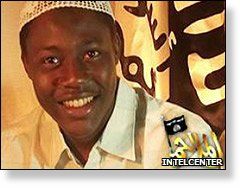
IntelCenter, a group of US ex-military and intelligence officials who over the years have somehow managed to produce many of the "al-Qaeda" videos and messages that they serendipitously find on "jihadist websites", produced a picture of Mutallab with what they claim is the flag of the media arm of "al-Qaeda in the Arabian Peninsula" and a
message from the group claiming Mutallab as one of their own:
"We tell the American people that since you support the leaders who kill our women and children ... we have come to slaughter you (and) will strike you with no previous (warning), our vengeance is near," the statement said
Scared yet? Well, the people at
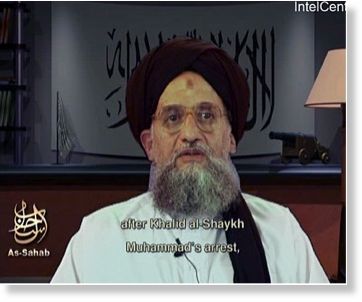
Intelcenter really hope you are. They put a lot of effort into producing these messages and videos and images. For example, a 2006 'al-qaeda' video featuring al-Zawahiri released by
Intelcenter was analyzed by Neal Krawetz, a researcher and computer security consultant. During a presentation he gave at the BlackHat security conference in Las Vegas in 2007 about analyzing digital photographs and video images for alterations and enhancements, Krawetz showed that the video had been altered in a very interesting way.
Using a program he wrote (and provided on the conference CD-ROM) Krawetz could print out the quantization tables in a JPEG file (that indicate how the image was compressed) and determine the last tool that created the image - that is, the make and model of the camera if the image is original or the version of Photoshop that was used to alter and re-save the image.

A still from the the Intelcenter-faked "al-qaeda" video
Krawetz took an image (above) from the 2006 video of al-Zawahiri showing the
Mr Magoo look-alike sitting in front of a desk and banner with writing on it. After conducting his error analysis Krawetz
was able to determine that the writing on the banner behind al-Zawahiri's head was added to the image afterward and at the same time as the logo of IntelCenter, which released the video. In short, it seems very likely that
IntelCenter produced the writing on the banner, and probably the entire video, from whole cloth.
Despite this evidence, we are being asked to believe that the latest message and photo from 'al-Qaeda in the Arabian Peninsula' that
IntelCenter just happened to find on a "Jihadist internet message board" that links Mutallab with 'al-Qaeda in Yemen' is authentic!

An image of Mutallab with 'al-qaeda logo' procured (manufactured?) by Intelcenter
The Yemen government, or rather dictatorship, added its voice to the subterfuge by claiming that Mutallab was in Yemen from August to December 2009. Dodgy internet postings, as usual from unnamed 'jihadist web sites' would have us believe he was putting the final touches to his knicker bomb under the tutelage of "al-Qaeda in the Arabian Peninsula" and specifically Anwar al-Awlaki, the US born Muslim lecturer, spiritual leader, and former imam. The very same al-Awlaki who allegedly corresponded with
Fort Hood mind-programmed patsy Nidal Malik Hasan. The very same al-Awlaki who was
allegedly the spiritual adviser to two of the 9/11 hijackers. Isn't it just wonderful how it all connects together in one giant web of "Muslim terrorism" that starts with 9/11?
The fact is, it all
does start with 9/11, and the evidence that the 9/11 attacks were perpetrated by elements of the US and Israeli governments is so abundant that no further discussion is required. How Mutallab
actually passed his time in Yemen is however still open to speculation, and speculation is always best when some reasonably objective data is marshaled to back it up. Data like:
Yemen seizes 'Israel-linked' cell
Tuesday, 7 October 2008
BBC News
Yemeni President Ali Abdullah Saleh has said the security forces have arrested a group of alleged Islamist militants linked to Israeli intelligence.
Mr Saleh did not say what evidence had been found to show the group's links with Israel, a regional enemy of Yemen.
The arrests were connected with an attack on the US embassy in Sanaa last month which killed at least 18 people, official sources were quoted saying.
Israel's foreign ministry has rejected the accusation as "totally ridiculous".
"A terrorist cell was arrested and will be referred to the judicial authorities for its links with the Israeli intelligence services," Mr Saleh told a gathering at al-Mukalla University in Hadramawt province.
"Details of the trial will be announced later. You will hear about what goes on in the proceedings," he added.
The 17 September attack was the second to target the US embassy since April. Militants detonated car bombs before firing rockets at the heavily fortified building.
Mr Saleh did not identify the suspects, but official sources were quoted saying it was the same cell - led by a militant called Abu al-Ghaith al-Yamani - whose arrest was announced a week after the attack.
The simple yet ugly truth is that Yemen is now squarely in the cross-hairs of the US imperial juggernaut. As to the reason why, we may need only look to the following report from Feb 2009:
Yemen oil majors mull investments
Yemen's Ministry for Oil and Mineral Resources has received eight oil investment bids from international companies, pan-Arab daily al-Hayat quoted Aidarous as saying, four of which were from oil majors seeking direct negotiations with Yemen.
The companies include Exxon Mobil, Total, and BP, the minister said, but did not elaborate on the nature of the investments.
Yemen also has significant natural gas reserves that are in the process of being explored and extracted by French Multi-national
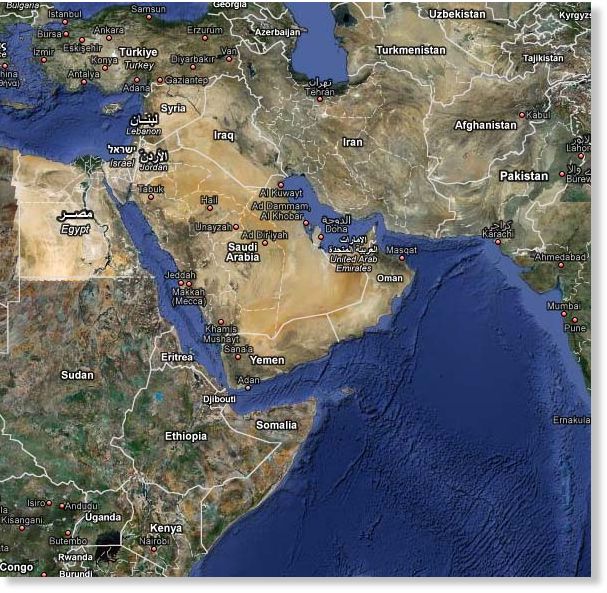
Total. But perhaps Yemen's most strategically important asset is its location. Sitting on the southern tip of the Arabian peninsula, the Yemeni sea port of Aden and the gulf of Aden in general is ideally located for the transport of the two aforementioned crucially important commodities. Over 30% of all crude oil and over 10% of global trade pass through the Gulf of Aden and control of it gives control over shipping in the region (think piracy) and access to the coasts of oil-rich East African nations like Somalia and Sudan.

Yemen, showing the gulf of Aden to the south and Somalia and Sudan to the South West
With climate change, in the form of a glacial rebound or a new 'ice age', and the massive world-wide social unrest it would cause, looking increasingly likely in the near future, the psychopathic elite are undoubtedly eager to ensure their own comfortable survival at our expense.
Yemen - Yesterday And Today Yemen has only existed as an independent country for less than 50 years. During and after the Second World War, Aden was regarded as the key to the defense of British imperial interests in the Middle East, the Gulf and the Indian Ocean. As late as May 1956 a British junior minister, Lord Lloyd, stated that "for the foreseeable future it would not be reasonable or sensible or in the interests of the colony's inhabitants to aspire to any aim beyond that of a considerable degree of internal self-government."
1 Naturally enough, Yenemis were less than enthusiastic about being indefinitely subservient to the British.
Historically, Yemen had been split into two governates, North and South Yemen. In 1956, as long as its then ruler
Imam Ahmed did not interfere, the British were willing to allow North Yemen relative independence. South Yemen however was to remain fully British, at least economically. In response to an increasingly powerful trade union movement made up of the Arab working class who demanded better wages, living standards and infrastructure, the British attempted to consolidate their control in the South by establishing the Federation of South Arabia in 1959, a ramshackle affair made up of the various emirs, sheiks and sultans who were willing to side with the British against Yemeni nationalist aspirations in exchange for position and wealth.
British Petroleum had established an oil refinery in 1954 and the wealth that this resource could and should have provided for the Yemeni people was instead shipped out to further British strategic interests elsewhere in the world, leaving much of Yemen's population impoverished. While the British governing elite have always (and still do) view all (or rather most) non-Western peoples as little more than howling savages, like so many other colonized nations, the Yemeni people had no trouble recognizing the injustice of the situation. Faced with an increasingly militant nationalist movement within both South and North Yemen, the British reacted to the justified grievances of a mobilized civilian population in the only way they know how - subterfuge and force.
After a wave of strikes called by the Aden Trades Union Congress (how dare they!) which were followed by mass arrests, beatings and torture by the British military, a number of activists and organizations from Aden and outlying areas came together to establish the
National Liberation Front for Occupied South Yemen or the NLF for short. The leaders were middle class... clerks, teachers, officers.
2 To deal with the insurgents ('terrorists' in modern parlance), the British decided on the tried and trusted method of terrorizing the local population. They proclaimed the insurgent areas 'proscribed areas' and dropped leaflets telling the inhabitants to leave (does this remind you of the tactics of a certain Middle Eastern country in January 2009?). With that formality completed the Royal Air Force freely rocketed and bombed the areas, strafing any sign of human activity. Crops were destroyed, livestock seized and houses blown up, (again, does this remind you of anything?) When Yemeni farmers began to work their fields at night, the British military added night-time bombing.
3 Search operations were carried out on a large scale in an attempt to restrict movement of men and weapons by the NLF. Inevitably, these searches accompanied by racists abuse and physical manhandling further alienated the population. Stephen Harper, the
Daily Express correspondent in Aden, wrote fondly of the troops that "there's a lot of boot, gun-butt and fist thumping" but that this wasn't brutality but rather "righteous anger". An officer recalled how, when troops were banned from calling the Arabs 'wog', they wittily responded by calling them 'gollies' instead
14 (see here for the origin and usage of the world
golliwog). The counter-productivity of such abuse always was (and still is) lost on the British political elite and military and obviously did nothing to win the 'hearts and minds' of the Yemeni people in their rebelling against foreign domination.
Another tactic used by the British military (you may recognize this one) was the deployment of 'Special Branch Sections'. These were eight to ten man mobile patrols with an officer in command. Dressed up as Arabs they carried out raids, searches and attacks against British and Yemeni civilian and military targets that could then be blamed on the insurgents in an effort to justify the British oppression. The SAS in its first official deployment against urban guerillas was also deployed in 'Keeni Meeni' squads (a Swahili term appropriately meaning 'slithering snakes'). 'Keeni Meeni' members were SAS men thought most likely to be able to pass for Arabs...
5 Without intelligence sources within the local Arab population, British military leaders settled on the inspired idea that torture of prisoners was the next best thing. This mainly involved beatings of one form or another but also sensory deprivation techniques that would later be used in the 30 years dirty war in Northern Ireland and more recently in Iraq and Afghanistan.
At the time, allegations of torture and brutality were made in the British press against the Argyll and Sutherland Highlanders, an infantry regiment of the British Army. The conviction of members of the regiment in 1981 for the brutal murder of two catholic farmers in Northern Ireland in 1972 led to revelations about events in Yemen. The Glasgow
Sunday Mail reported that it had:
conducted a careful and comprehensive investigation including the sworn statements of a dozen soldiers and officers detailing murder and robbery of local Arabs. A single soldier admitted shooting dead five unarmed Arab civilians in different incidents. Several others said they used morphine injections to kill captives. Others claimed to be witnesses to the bayonetting to death of a Arab teenager whose only crime was to be found in a cafe after curfew.6
Eventually, the British were forced out of Yemen (at least physically) and the two kingdoms of North and South Yemen were formally united as the Republic of Yemen on May 22, 1990. Yemen's complicated history since British withdrawal and the unification of the North and South is beyond the scope of this article. Nevertheless, even a brief analysis of the social and political history of Yemen over the past 50 years is enough to show that the vast majority of internal conflicts have been over one single issue - civil rights and the desire of normal people to live a dignified existence free from oppression and inequality. When such aspirations conflict (as they invariably do) with the 'geo-strategic' interests of world powers like the US, Britain, or the megalomaniacal pseudo-religious and racist ideals of the state of Israel, normal people lose. 100 years ago, the British elite could simply crush such popular uprisings and explain it away as just the fall-out from their munificent efforts to civilize a 'backward people'. Today however, it is not so easy to fool a somewhat more enlightened world public and a more convincing argument must be made. That argument is today called "the world-wide terrorist threat".
In Yemen today, the people that the US, British and Israeli governments claim are "Muslim terrorists", "al-Qaeda in the Arabian Peninsula", 'al-Qaeda in Yemen" etc. etc. are in fact local tribesmen and their families who are clamoring for social justice and have been doing so for several decades. They would very probably be easily enticed to put down their arms if they were given economic help and simple concessions such as roads and schools by the government. But that is too much to ask of either the global power brokers or Yemen's puppet government. To give any power to the people is, in the twisted, greed-driven minds of the global elite, the first step on the road to the loss of control, and control over normal human beings and our planet is the lifeblood of our corrupt and psychologically deviant leaders.
And so we are led back to the knicker bomber who, we are told, was trained by Muslim terrorists in Yemen. In response to this bogus threat (
and indeed before it even appeared) the US military (and it's Saudi Arabian allies), like the British military before them, have been
bombing, rocketing and strafing, not 'al-Qaeda in Yemen', but
ordinary Yemeni civilians and
tribesmen who dared to raise their their voices, fists and guns against imperial and domestic injustice.
Notes Glen Balfour-Paul, The End of Empire in the Middle East, Cambridge 1991, p.67
Joseph Kostiner, The Struggle for South Yemen, London 1984, p. 53
John Newsinger, British Counter-Insurgency, Palgrave 2002, p. 117
Stephen Harper, Last Sunset, London 1978, p. 85
Tony Geraghty, Who Dares Wins, London 1992, p. 400-403
David Ledger, Shifting Sands: British in South Arabia 1981, Peninsular